
 The South African
INTRODUCTION
This article is a broad overview of the Intelligence structures in the SA Military context, a great deal more can be written on Intelligence functions, origin and development for each aspect of each Arm of Service, as well as each category of Intelligence and each unit in the structure. Intelligence does not function on its own, but operates within a political, social and economic environment to meet its mandate, and this cannot be separated from this context when reviewing the evolution of structures and functions over time. The reader is encouraged to delve into this fascinating topic to research the unique history and astounding contributions made by South Africans over the decades.
The current South African National Defence Force (SANDF)as a military organisation has evolved over many decades, spanning back to the Second Anglo Boer War (1899-1903) – in fact, less formal structures can be traced back to the Zulu empire, with Zulu Impi being utilised as scouts for reconnaissance against the British colonial forces.
Prior to the start of the Second Anglo Boer War, President Paul Kruger’s Geheime Dienst was operating under the authority of the then State Attorney Jan Smuts. Although a State Secret Service organisation, its function was primarily to determine the military capabilities and intentions of the British forces, thus can be indirectly considered as the first South African Military Intelligence structure.
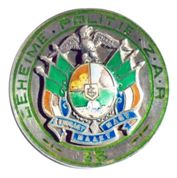
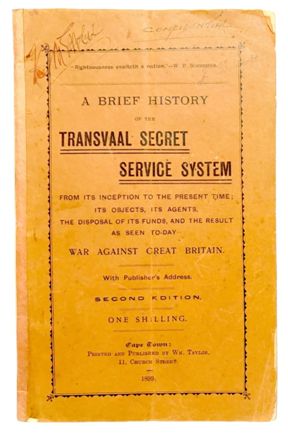
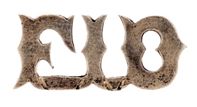
Most notable in the Intelligence environment during the war was the establishment of the Intelligence Department and the Field Intelligence Department (FID)by the British during the Second Anglo Boer War, the first official tactical intelligence capability development for British Military Intelligence.
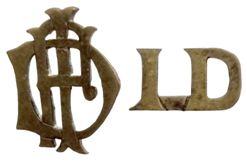
During the Second Anglo Boer War many Scout Regiments and units were established, utilising woodsmen, hunters, farmers and the hardy men of the land with field experience for tracking to locate and engage the elusive and veld-proficient Boers. Many of these units continued into World War 1 and 2 (WW1/WW2) with great success in battle. Examples of these units are Driscoll’s Scouts, French’s Scouts, Lovat’s Scouts, Colonial Scouts, Neyland’s Imperial Scouts,and Naudé’s Scouts.
Kommandant Danie Theron’s Rapportryers are probably the best-known Boer intelligence unit, along with other Boer scout groups and individuals that were incorporated into the Union Defence Force.
Another significant outcome of the Second Anglo Boer War was the creation of the Boy Scout Movement by Colonel Robert Baden-Powell during the siege of Mafeking, taking advantage of the availability of skilled young boys at a time when soldiers were not available for his reconnaissance requirements. Col Baden-Powell had by then written at least two manuals on Scouting and Reconnaissance for the British military. On this foundation, the British Regimental Scout and Scout Sergeant musterings were implemented in 1905 and utilised until after WW1. This proficiency badge was issued in South Africa and Rhodesia until the 1970s.
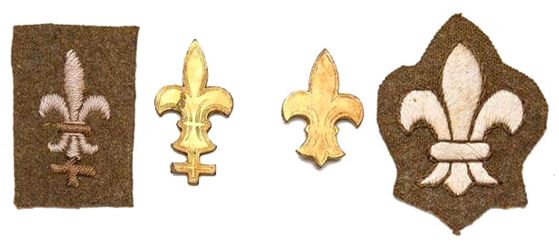
Summarising the origins of our Defence Force broadly then, after the end of the Second Anglo Boer War the British and Boer forces combined to create the Union Defence Force (UDF) under control of a British colonial government structure. As such, the UDF largely followed the British military organisational model and development from before WW1, during the inter-war years and into WW2.
The South African Intelligence Corps was established with effect from 1 February 1940 as a unit of the South African Citizen Force, with the British Intelligence Corps being established by Special Army Order 12 of 1940 on 15 July 1940.
As part of the British Commonwealth, South Africa wore the same insignia as the British military, such as the British Intelligence Corps laurel wreath cap badge and shoulder titles. British officers wore silver badges, while other ranks were issued with brass badges.
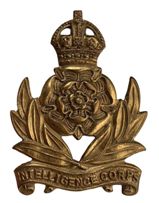
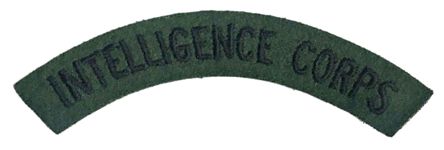
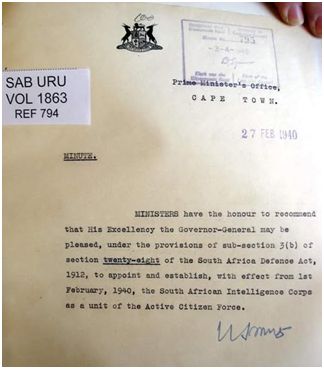
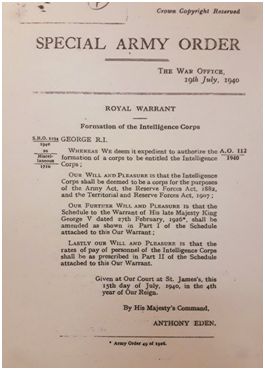
Dave Kenny compiled the following section on further early developments:
1 February is the day the SA Intelligence Corps was established. There were prior Intelligence Corps’ established beforehand in WW1 – see ACF list below:
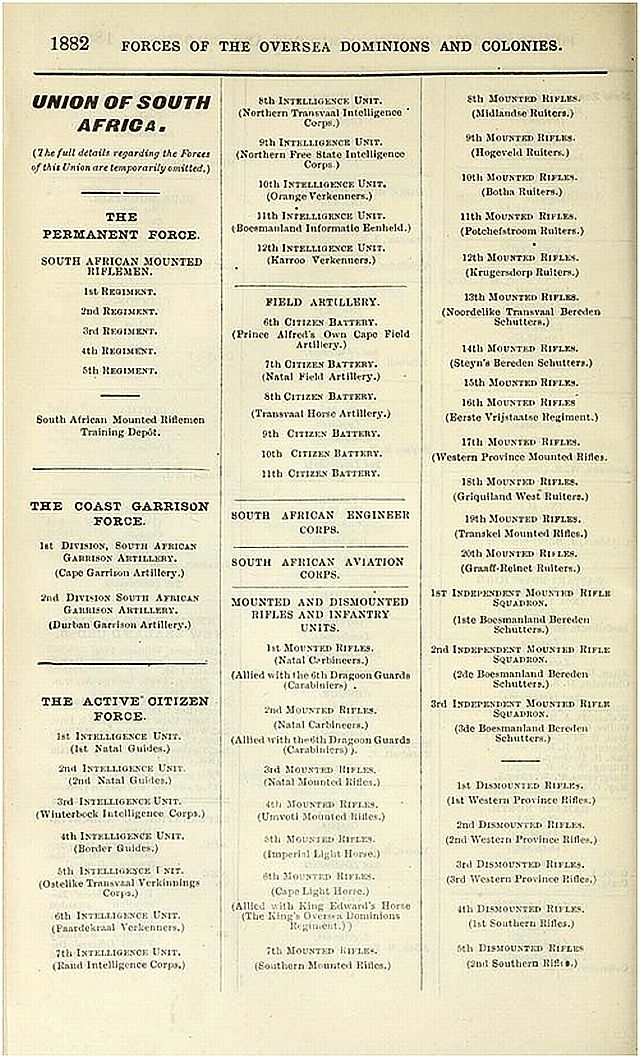
Other versions of the SA Intelligence Corps were to be established later, the SA Military Intelligence Corps on 1 Jan 1968 and SAArmy Intelligence Corps in 1978 or 1980, but 1 February 1940 is the start-date of an Intelligence Corps as we know it.
At the start of WW2 there was a fair amount of Intelligence chaos prevailing in SA with several (competing) structures engaged in the Intelligence business. In 1939 there was a nascent Intelligence Headquarters (HQ) of only four officers: Lt Col Barney Thwaites (Assistant Director Military Intelligence), Maj. J. McGarel Groves, Capt.’s A. Chapman, and G. Makepeace, but this was to rapidly grow to a MI Division of 31 Officers and 42 Other Ranks. Most of the OR’s were Field Security Police / Personnel (FSP) with previous investigative experience in the SAP or Railways – one even had FID experience from the ABW!
Our history is very confusing at the outset because the Int Corps (as in field Int, not MI division int) was created to support the Mobile Frontier Force in East Africa. The East African Intelligence Corps (EA Int C), had been created at the same time and was integrated with the SA Int C with interlocking command structures but separate areas of operation. The combined Int Corps had a total strength of the Corps was 173 “Europeans” and 50 “non-whites”. The total officer strength was 29. There were no officers on brigade level. There were 8 bicycles, 40 motor bikes, 13 cars, one lorry and 12 pistols on strength.
The Corps was to take a more cohesive form during the year, and by December of 1940 the SA Int C consisted of 178 men and 90 officers. See organogram for development of the structures, noting that the Corps was only one part of the overall MI Division.
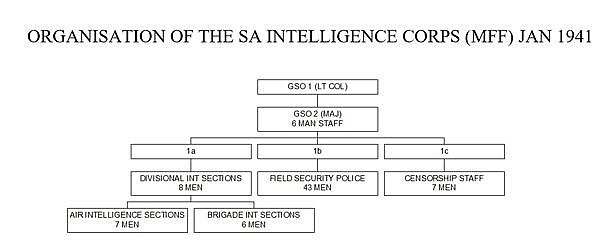
The main sub-unit within the Corps was a Field Security Section (FSS) and there were a number of these created, both in SA e.g. Durban, Pretoria, Cullinan, Premier Mines, Cape Town, Pmb, EL etc. FSS’s were created in East Africa to protect “Lines of Communication” and to operate with forward units. Later the SA Divisions in Egypt / N Africa and in Italy (e.g. 6 SA Armoured Division FSS) all developed their own FS structures.
South African field intelligence staff developed a good reputation and numbers of them were deployed to special units and tasks all over the Middle East, Mediterranean, and Balkans (and later, the Far East). Others served in the European theatre and with the Royal Marines. Several gravitated to the Special Operations Executive and to special operations with T Force, S Force, Control Commission Germany, Indian Field Broadcasting Unit, No 1. Special Force, and with various Allied Command structures.
Sadly, a number of SA Int Corps members were KIA or KOAS, many in plane crashes or ship sinkings. Numbers were captured at Tobruk and elsewhere, and several of these escaped and joined partisan gangs in behind-the-lines resistance. Many members of the Corps were decorated for their war service and the Corps counted several MBE’s OBE’s, DSO’s, MC’s / MM’s, and MiD’s amongst its members. A disproportionate number of awards for what was a very small number of men.
Sadly, the Corps was to fall foul of immediate post-war politics. Truck-loads of files and records were confiscated by the MP’s and taken away for destruction. The Corps just seems to have faded away.
Dave Kenny continues to do prolific research on South African Intelligence Corps contribution to the international development of the Intelligence Community, as does Col (Ret) Dudley Wall.
Emerging from WW2 into the Cold War era, Intelligence as a capability and function developed in leaps and bounds, aided by massive strides in technology and international co-operation.
It is important here to outline the various levels and categories of Intelligence capability, to help understand the development of the structures they necessitated and for reference going forward.
Role of Intelligence
The purpose of Intelligence is simply to deliver accurate truth in a timely manner, to those with the power to act on it. Intelligence is information that has been processed and analysed to formulate as complete a picture as possible of what is being presented.
Category: Strategic Intelligence
This is the top level of intelligence, providing insights into long-term decision-making and actions regarding the threats to the country or military force. At State-level in South Africa, this function was manged by the Department of Foreign Affairs, the National Intelligence Service (NIS) pre-1994,) and post-1994 by the National Intelligence Agency (NIA) and South Africa Secret Service (SASS) – later combined to be the State Security Agency (SSA).
Category: Criminal Intelligence
The South African police manage this function, pre-1994 this included counter-terrorism functions that were tasked to the SA Police (SAP) Special Branch, evolving to the SAP Security Branch and then Republican Intelligence, and later the Bureau for State Security (BfSS, known better as BoSS). BfSS evolved into the Department of National Security (DoNS), that became the NIS. In the post-1994 era, national security was allocated to NIA, and the SA Police Service (SAPS) focused on crime with their Directorate of Criminal Intelligence.
Category: Tactical Intelligence
Tactical intelligence defines what is happening on the battlefield – Opponent intentions and capabilities – whether by land, sea, air or cyber environments. It deals with the opponent’s force strength, equipment, tactics, command personalities, location, and movements. Tactical intelligence also covers the geospatial environment – the terrain both own and opponent will be engaging in. To gather information of these various aspects of the intelligence requirement, there are a number of capabilities and functions that are implemented as required:
a. Human intelligence (HUMINT) – This is the deployment of personnel into the field to physically gather information on the opponent by means of observation, surveillance, reconnaissance, tracking and monitoring from concealed locations such as observation posts (OPs). Special Forces (SF) Operators, Infantry Reconnaissance Platoons or Scouts, and Airborne Pathfinder troops can be utilised.
b. Image Intelligence (IMINT) – This is the advantage gained by aerial photography of the opponent and the environment by aircraft such as low altitude single-engine fixed-wing airplanes (Kudu/Bosbok/Cessna/Pilatus, etc), Unmanned Aerial Vehicles (UAV/drones), jet aircraft with photo-reconnaissance pods attached (Photo-Recce), high altitude surveillance by jumbo (60 Squadron Boeings) and satellites can provide such images.
c. Signals Intelligence (SIGINT) and Electronic Intelligence (ELINT) – Opposition force radio signals and electronic communications are intercepted and analysed by foreign language specialist operators.
d. Terrain Intelligence (TERRAIN INT) or Geo-spatial Intelligence (GEOINT) - utilises surveyors and geographic information systems (GIS) to analyse the terrain of the environment in the area of interest, including meteorological data pertaining to weather systems.
e. Cyber Intelligence (CYBERINT) – this is a relatively new development required by the technological advancement that computer systems and networks have brough to the equation.
In the SA Military, each Arm of Service had similar musterings/proficiencies:
| SA Army | SA Air Force | SA Navy | SA Medical Services |
|---|---|---|---|
| HUMINT: Army Intelligence, counter-intelligence, unit security & Civil Affairs/ComOps, PsyOps Signals Corps Corps of Engineers Special Forces:Infiltration reconnaissance Infantry Corps:Tracking, scouting by horse and motorbike, observation, recon platoons Armour Corps:Armoured recon Artillery Corps:Enemy location by radar |
Aerial Recon:
Central Photographic Unit and Photo Recce by Squadrons Joint Aerial Reconnaissance Intelligence Centre (JARIC) ELINT/SIGINT: Intelligence proficiency for LS2 members Air Terrain Int: |
Musterings for:
Intelligence, Communications Intelligence, Electronic Warfare, Radar Operator, Signals, Operational Photography, Survey (SAS Protea) of ocean floor and channels |
No official proficiency category, but had capability for Intelligence, Counter Intelligence and ComOps.
Also responsible for Nuclear, Chemical and Biological (NCB) intelligence |
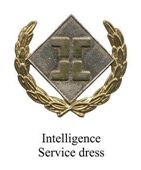
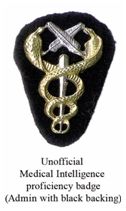
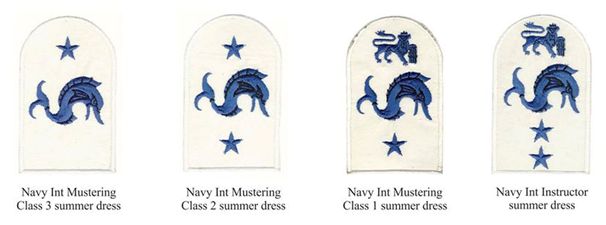
SA Navy Officers did not wear mustering insignia, but Warrant Officers (WOs) and other ranks wore the mustering insignia on their left shoulder sleeve. Instructors wore the insignia above their left chest pocket.
The focus of the development of intelligence in the military environment leads us to review how these categories and capabilities are employed in South African context. It is necessary to divide this development into the pre- and post-1994 eras, as the social-political environment the military operates requires this. The pre-1994 era had the South African Defence Force (SADF), created after South Africa became a Republic (RSA) on May 31, 1961 under the National Party regime. Evolving from the Union Defence Force (UDF) and British rule, much of the British military heritage was retained. The most notable aspect of this development era is that computer technology was still in its infancy, which largely became more prominent in the post-1994 era when the South African National Defence Force (SANDF) was established under the African National Congress regime.
As mentioned earlier by Dave Kenny, after WW2 the South African Intelligence Corps all but vanished. The British managed the intelligence environment via their structures and personnel that were put in place in South Africa. The UDF adopted a posture of defence rather than offence, and the military aspect of society was largely downplayed. However, the changing socio-political environment in Africa was changing rapidly in the Cold War era, with the Communist East-Bloc of the USSR and its alliances pushing into developing economies and influencing violent regime change in particularly African and South American countries. This brought about a change in the southern-African regional perspective of defence, with Rhodesia's Unilateral Declaration of Independence (UDI) from Britain adopted on 11 November 1965. Angola and Mozambique became involved in their own civil wars, aided by communist Cuban and Soviet-backed forces, after the fall of Portuguese colonial rule in 1974.
South-West Africa (SWA) – now Namibia – was a protectorate of South Africa, to which the South African government did not want to grant independence until all Cuban troops had withdrawn from Angola. SWA was seen as the last barrier to prevent direct military attacks by Soviet-backed military forces against the RSA.
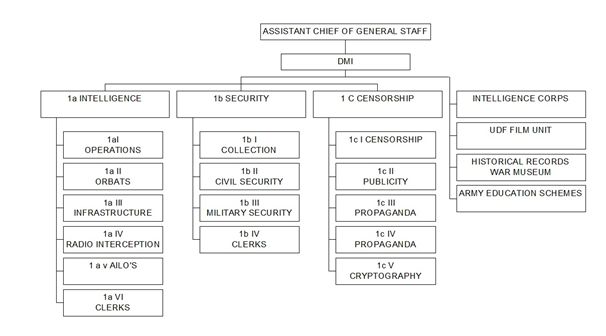
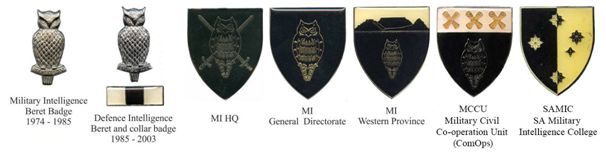
In an interview with Major General ‘Fritz’ Loots while researching the history for the Special Forces Brigade that he established, he mentioned that was brought back from retirement and re-appointed Director of Military Intelligence (DMI) in 1974, having been a Senior Staff Officer at DMI during 1965, and Director of Military Intelligence 1966-1970. When he walked into the Directorate, it was being run by British officers, whom he tells me he promptly had removed from the building. The structure of the DMI is as shown below:
In 1975-76, the SADF launched a covert full-scale conventional attack into Angola, coming within sight of the capital Luanda, before international exposure and pressure resulted in a hasty withdrawal after the United States of America withdrew its support.
Numerous lessons were learned from Operation Savannah, a key outcome being that an offensive position of defence was adopted and the SADF capability was significantly bolstered. One of the shortcomings of Ops Savannah was the lack of a tactical intelligence capability, and over-reliance on international coalitions.
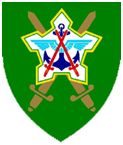
images from https://sadf.info/SADF.html
The SADF was structured into five main Command Sections:
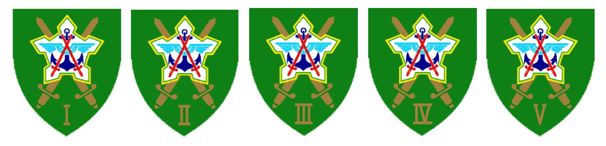
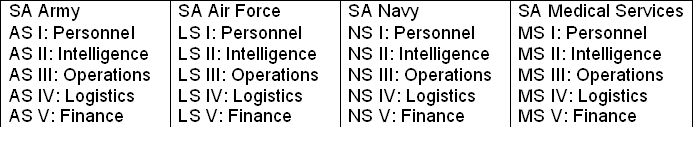
Each Arm of Service had the same Command Sections: table is int21
Functionally, for the SA Army the four provinces of the RSA were divided into 11 Commands, with each regional Command also having its own five Command Sections.
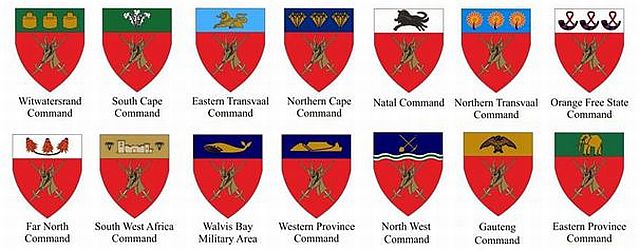
Col (Ret) Dudley Wall provided the following graphics for illustration.
The Command Section sub-unit tactical symbols are as follows, in the colours of the SA Army.
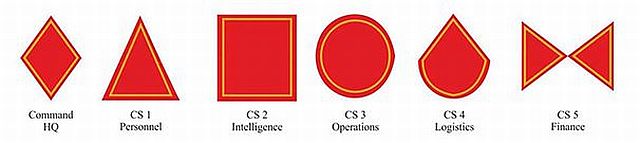
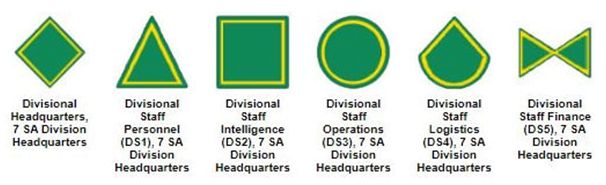
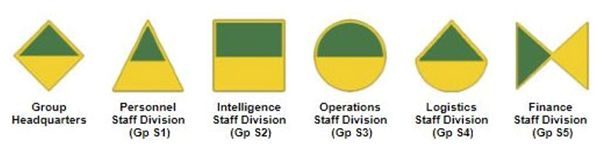
Each individual unit/squadron or Naval base/ship of the various Arms of Service were also structured according to the five Sections.
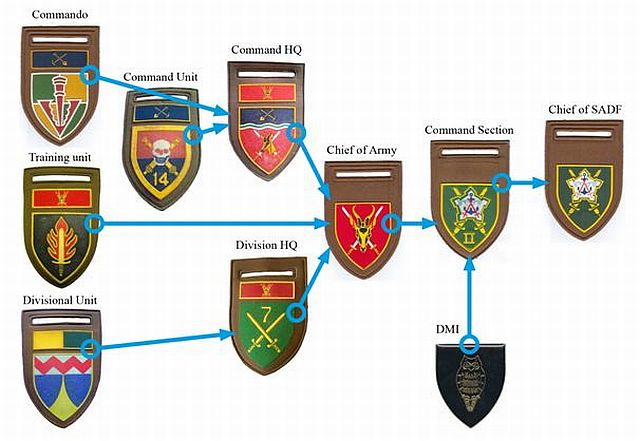
The reporting structure worked as follows:Commando/Regiment Int Section reported to regional Command Int, Unit Int Section reported to regional Command Int, which sent all to the Arm of Service Int branch, who reported to CSADF II, that collated all reports and submitted to the Chief of the Defence Force.
The reporting structure was indicated by the higher formation bars above the unit shoulder flash on the left arm, while the HQ/Command compartment section or unit’s company/squadron tactical symbol was on the right arm.
The reporting structure is illustrated in the diagramme below:
Established on 1 July 1962, DMI was a strategic intelligence function of the SADF, with too few operatives on the ground to make effective tactical intelligence gathering possible in the fast-growing conventional environment.
While DMI has the Mandate to collect and conduct intelligence functions of a military nature, the decision was made to create a tactical intelligence capability for the other operational Arms of Service in the SADF: The Army, Air Force, Navy and Medical Services.
Intelligence Corps training incorporates the Army, SAAF, Navy and Medical members. DMI provides training for its members at the SA Military Intelligence College (SAMIC) in Pretoria. SAMIC could not process the volume that was required for tactical intelligence requirements by the Arms of Service, nor could the School of Infantry meet the requirement for Intelligence Corps Officers and NCOs. With National service bringing in sufficient troopsof predominantly European SA male citizens (women, as well as Black, Coloured and Indian demographics could volunteer) for longer periods of service – at first for 1 year, then extended to two years in 1977, with ongoing short-term camps, the decision was made to create the Army Intelligence Corps, which was established in 1978.
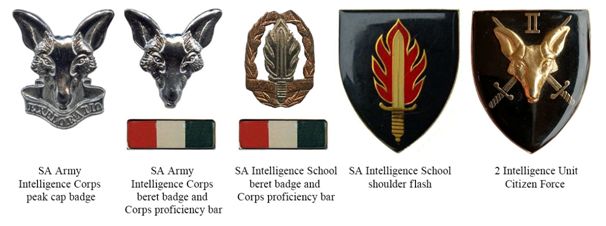
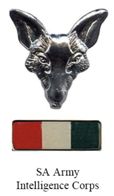
The Corps colours were red, white and green. These symbolised the unified intelligence capabilities of the SA Corps of Artillery, SA Armour Corps and SA Infantry Corps.
While Security courses were presented at the Intelligence Branch of the SA Army College in Pretoria. The first formal Army Intelligence course presented was Army College Course G7640 Unit Intelligence Corporals (NSM), from 20 September to 15 October 1976. Army Intelligence training also took place in Kemberley at 11 Commando, an Infantry training unit for Commando and Citizen Force troops, from early in 1979. Courses were presented for Intelligence, Counter-Intelligence and Civil Affairs. In September 1982, 11 Commando changed name and Corps, and the SA Intelligence School (SAINTS) was established for Junior Leader training of Officers and NCOs (Lieutenants and Corporals) in the fields of Intelligence, Counter-Intelligence and Communications Operations (ComOps), as well as Intelligence Clerks. The SAINTS Course Wing also presented coursesfor Unit Security, Interrogation, Operational Photography, amongst others. Members of the Army, Air Force, Navy and Medical Services attended this training.
The SADF provided separate initial training for women. The ladies underwent basic training at the Women’s College in George in the Eastern Cape. Initial Army Intelligence was also presented for those selected at the Women’s College. After completing the training and being appointed as Officers, NCOs or Clerks they could then undergo further training at SAINTS or SAMIC, together with their male counterparts.
In the SADF, Intelligence Corps personnel were placed at each unit as Intelligence, Counterintelligence (CI) and Unit Military Security Officers (UMSO), WOs, NCOs and Clerks. The Junior Leaders (Lieutenants and Corporals) that graduated from SAINTS totalled between 800 and 1 200 each year until 1989.
As National Service (NS) lasted only 2 years, training levels were maintained by allocating the soldiers leaving the NS system to Citizen Force (CF) units, Regiments or Commandos in the soldier’s town or city where they resided. Part-time training and administrative duties were undertaken one night a week, with continuation training over some weekends and extended call-ups for full-time camps lasting from one to six months, often including operational deployment into the Angolan conflict areas or local townships to curb political unrest, in support of the SAP. The CF structure managing a group of part-time Intelligence personnel was 2 Intelligence Unit, established in January 1984 and based in Johannesburg, under the reporting structure of 7 SA Division.
SAINTS was located in the Diskobolos Military Area in Kimberley until the end of 1988, relocating to Potchefstroom for the 1989 National Service intake, taking over the base previously home to 3 SA Infantry Battalion (3SAI).
The SWA-Angolan Border War came to an end in October 1988, with the Cubans and Soviet-backed forces leaving Angola and the final withdrawal of the SADF from SWA – Namibia after independence was achieved – completed in 1991. The fall of the Berlin Wall in 1989 and the subsequent collapse of the Soviet East-Bloc USSR alliance was a further major factor contributing to the end of the Bush War for South Africa.
The requirement for National Service was reduced from 2 years to 18 months, then 1 year in 1989. Further force reductions followed, including the closing of a number of units, including the Danie Theron Combat School – an Infantry specialised training unit located next to the SAINTS base in Kimberley. In 1990, SAINTS was re-named Danie Theron Combat School (DTCS) in association with Kommandant Danie Theron as a forerunner of the SA Intelligence Corps. The sub-unit divisions of SAINTS were defined as Companies from their 11 Commando infantry roots, whereas under DTCS they were renamed as Squadrons in line with the Armour tradition.
With the transition to a more inclusive political dispensation in South Africa, there was a great deal of change in the military environment post-1994 with the election of the African National Congress (ANC) to replace the National Party as the ruling power. Notably, the former non-statutory liberation struggle military wings of the ANC, Pan-African Congress (PAC) as well at the military structures of the various independent Homelands (Bophutatswana, Venda, Transkei, Ciskei, Lebowa and KwaZulu-Natal,etc.) were incorporated into the new SA National Defence Force (SANDF), military service became voluntary and open to all races and genders.
With the major role played by Intelligence Corps and Special Forces (SF) members in pursuing the members of the liberation struggle parties, swift changes occurred in these organisational structures. SF was redesignated as 45 Parachute Battalion and relegated to obscurity as just another Infantry airborne unit. The tactical intelligence capabilities of the Army, Air Force, Navy and Medical Services were withdrawn and re-incorporated with MI, now renamed Defence Intelligence (DI). 2 Intelligence Unit was also disbanded early in 1997 and the personnel transferred to7 Signals Regiment.

The traditional Army Corps structure of the SADF was dismantled and replaced with Army Formation HQs in 2002. The Territorial Force was made redundant and the Commands, Group HQs and Commandoes were closed down in 2003. Regional Regiments were allocated into the Formation reporting structures, although many were amalgamated or closed down as well, while regional Joint Tactical HQs replaced the regional Command structures. The Citizen Force was redesignated and restructured as the SANDF Reserve Force (Res F), under control of the Res F Directorate. DTCS was renamed the School of Intelligence, and then later again renamed School of Tactical Intelligence, residing under the SA Army Intelligence Formation (Int Fmn).
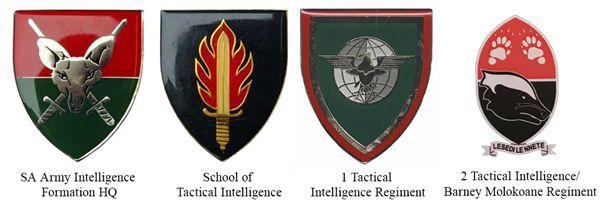
Another significant military operation influence the SANDF structure in September 1998. Operation Boleas was a joint South African and Botswana military intervention to restore stability to Lesotho, an independent state within South African borders. Numerous challenges during the operation highlighted the need for both a Special Forces and a tactical intelligence capability for the SANDF.
Following this operation, 1 Tactical Intelligence Regiment (1TIR) was established in 1998. The Regiment comprised Squadrons with Troop sections (platoon strength) to capabilities to provide Surveillance, Tactical Collection, Aerial Surveillance (UAV) and GIS functions. Units were no longer allocated Intelligence personnel – if an operational deployment was planned, a requirement was submitted to Intelligence Formation by the Joint Task Force HQ and 1TIR was tasked to provide a composite Squadron or Troop to meet the deployment requirement.
The other significant restructuring after Operation Boleas was that SF were re-established as Special Forces Brigade, with a dedicated SF Training School in Murrayhill, Pretoria. This development allowed for long-range reconnaissance and surveillance beyond our borders, and has proven exceptionally valuable in the many SANDF deployments into Africa on Peace-Keeping missions. The Battle of Bangui in the Central African Republic showcased the skill and courage of SF, Army Int and the SA Para Bn in severe conflict against overwhelming opposition numbers.
In 2017, 2 Tactical Intelligence Regiment (2TIR) – renamed the Barney Molokoane Regiment (BMR) was established as the SA Army Intelligence Formation’s reserve unit.
This article has only covered the broad history of the South African Intelligence Community and provided an outline of the structure of SA Army Intelligence from establishment to 2026. Far more can be covered on the intelligence role of Special Forces, SA Army Signals Intelligence, Infantry reconnaissance platoons and Armoured reconnaissance, Artillery Locating units, and the intelligence capabilities of the Air Force, Navy and Medical Services. Profiles of prominent individuals that contributed to local and international intelligence operations and development of structures are another interesting aspect. The reader is encouraged to delve deeper to gather and preserve the history of these obscure and unknown entities.
Return to Journal Index OR Society's Home page