
Take the R23 South from Greylingstad. Turn left on R547 towards the town of Val.
After 7.2 kilometers ignore the road to Val off to the right
After 7.7km cross the bridge over the railway line and take the next road to the left.
After another 1.1 km take road to left towards railway line.
Travel 3.6 km along road next to railway line.
Monument 50 meters off the road to your right on the culvert of the old railway line.
Inscription
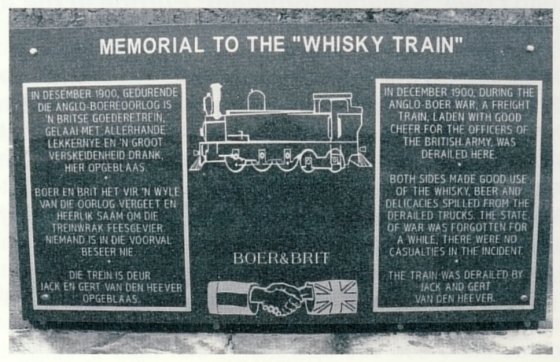
In Afrikaans and English.
In December 1900,during the Anglo Boer War, a freight train, laden with good cheer for the officers of the British Army,was derailed here.
Both sides made good use of the whisky, beer and delicacies spilled from the derailed trucks. The state of War was forgotten for awhile. There were no casualties in the incident.
The train was derailed by Jack and Gert van den Heever.
Significance
Note: * 'Whisky', not 'whiskey', which is Irish and, according to the Scots, for less discriminating drinkers
Everyone and everything can be famous for fifteen minutes. Val was famous in April 1902 when General Louis Botha arrived at the station and boarded a train to Johannesburg under a safe-conduct granted by the British Army. He was on his way to attend the negotiations about ending the Anglo-Boer War and a famous photograph shows him speaking with British officers on the platform.
The railway line from Volksrust to Elandsfontein (Germiston these days) was built by the Natal Government Railway and joined up with the Zuid-Afrikaansche Spoorweg Maatschappij's system in 1896. This connection opened up trade between the ZAR (Transvaal Republic) and the Colony of Natal. It was very useful when war was declared in October 1899.
After the capture of Johannesburg, Pretoria and Lydenburg by Lord Roberts's army, the line became one of the lifelines for supplies of food and munitions for the British army. The stretch of line between Standerton and Heidelberg was particularly vulnerable to attack. The Heidelbergers under Commandant Fanie Buys were especially adept at blowing up trains, culverts and even bridges.
The British eventually protected their railways with block houses sited at intervals of one thousand yards (914m), but in 1900 these little forts had yet to be built. More than thirty trains were blown up and derailed on this stretch of line before these defensive measures could be put in place.
In December 1900 Commandant Buys selected a likely place where a successful attack could be made on a passing train. The elevated line passed over a small stone culvert a short distance up the line from Val station. Undulations in the ground provided hiding places for the two men who must lay and detonate the mine. Two brothers were given that task and they spent several hours one night burying a bag of black powder between the lines. They used a magneto generator to explode the charge but, as they only had two hundred yards (183m) of wire, they had to hide themselves nearer than this to the train - and the explosion!
The brothers were Jack and Gert van den Heever and Jack later wrote an entertaining account of their night's work in a little book published in the 1940s, Op Kommando onder Kommandant Buys. The mine exploded under the goods train and several trucks turned over and rolled down the embankment. Buys's Heidelbergers galloped up to find the cargo of good cheer for the Christmas and New Year celebrations in Johannesburg and Pretoria spread liberally along the railway line. The party that ensued involved the captured 'Tommies' as well as Buys's men. Jack and Gert seem to have been the instigators. Indeed Jack, rather inebriated after perhaps an excess of sampling the many wares, extracted permission from one of the older commando members to marry one of his daughters which he duly did once the war was over.
Further reading
South African Military History Journal Vol 15 No 6, Dec 2012