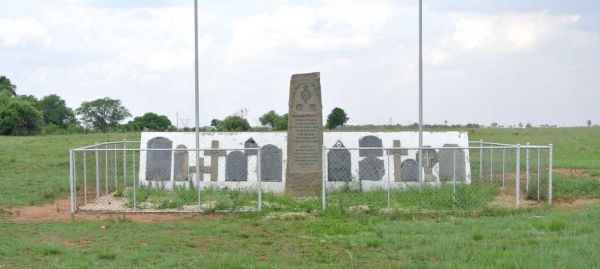
Take the N4 East from Pretoria. Take the Bronkhorstspruit offramp.
Turn right onto the R25.
After 2.5 kilometers along the road, the new cemetery is on your left 40 meter from the road.
Inscription
Significance
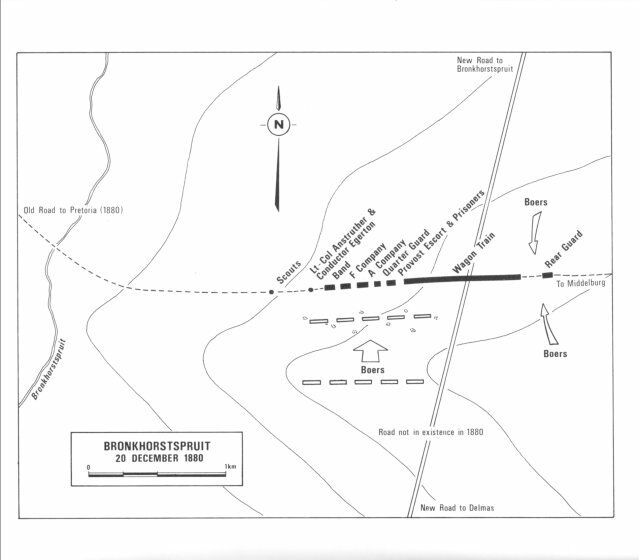
The column resumed the march on the 20th and at about midday Anstruther, with Conductor Egerton at his side, was riding about 50 m ahead of the band and about 400 m behind the two leading scouts when one of the scouts pointed out to him what he thought was a party of Boers, ahead, but moving off to a farmhouse on the flank. Anstruther after taking a long look through his binoculars said they were cattle, adding, 'Oh, those men are nothing'(7). The column continued for about another 1,5 km and was about 1,5 km away from a small spruit, known as Bronkhorstspruit, when the band suddenly stopped playing. Inquiring heads were turned and it was then seen that a party of about 150 Boers, on the crest of a low ridge, about 500 m on the column's left flank, was the cause
Anstruther immediately galloped back and gave the order for the column to halt and close up. While he was so doing a messenger, Burgher de Beer, who spoke English well, approached the head of the column under a flag of truce and bearing a letter. Conductor Egerton in his report states that he met the messenger and received the message which he duly handed to the Colonel. After delivering the letter de Beer added that, '... two minutes were allowed for an answer' to which the Colonel replied, 'I have my order to proceed with all possible despatch to Pretoria, and to Pretoria I am going, but tell the Commandant I have no wish to meet him in a hostile spirit'(8).
From various eye-witness reports it would appear that the main Boer party had not only increased in numbers during the negotiations to about 250-300 but had also decreased the distance separating it from the 94th by moving down the forward slope of the low ridge to about 150-200 m distance - an area, in fact, offering scant cover except for some scattered thorn trees. Most accounts say that the Boers had the advantage of high ground, a large number of boulders and heavy bush. A glance at any of the photographs of the area at the time will convince the reader that this was not so and that the area, as it is today, is considerably more wooded than it was in 1880. The high ground generally referred to is a gentle slope towards the south. Like so many exaggerations and misstatements about the war even the terrain has been described in such a manner as to give the impression that the 94th had to battle against both the Boers and the road. A typical example is James Grant in 'British Battles on Land and Sea, 1897 (page 335) '.. The Colonel had permitted some of his soldiers to sling their arms, and even to pile them by the wayside, while putting their shoulders to the waggon wheels, like active and earnest fellows, as they were, to urge the heavy convoy along a rough and precipitous road.' Anyone who knows the road will know that it is anything but precipitous and, in fact, where the battle took place slopes gently towards the spruit.
The messenger then returned to deliver Anstruther's answer to the Commandant, Frans Joubert, and it is here that one finds many different accounts as to the stage at which firing commenced. De Beer states that it was after he delivered Anstruther's message. Conductor Egerton seems to bear out this, stating, 'Each party galloped back to his own force, and no sooner had he reached it than the Boers commenced firing.' Anstruther said, 'He agreed to take my message, and I asked him to let me know the result, to which he nodded assent and rode off. Almost immediately fire was opened on us. I ran back and ordered F Company to attack, but before they could open out a murderous fire was brought to bear on them.'(9)
According to H.J.C. Pieterse the 94th started taking up battle formation the moment they spotted the line of Boers on the crest of the ridge. He goes on to say that it was done with military precision and order (Alles geskied knaphandig en stram-stram volgens militêre reël en orde'). He adds further that he cannot understand why they made no attempt to take cover behind the wagons.(10)
Lt J.J.F. Hume, who was commanding A Company, stated that de Beer was shot off his horse before reaching the Boers but, as we know this was not so, his version should not be taken into account. It is, however, obvious that little time was lost between Anstruther's giving his message to de Beer and the commencement of hostilities. Assuming, however, that de Beer gave the reply, either by word or pre-arranged signal, it would appear that the message was definite enough to convey to the Boers that Anstruther intended moving to Pretoria and, therefore, sufficient reason for them to attack in order to prevent him from so doing.
One can argue that the matter was still subject to negotiation and that the Boer attack was premature. This might be correct but, in tense times such as these, as anyone who has awaited an order to advance into battle will know, finer points of this nature are inclined to be overlooked. However, whichever way one looks at this question, the attack cannot be termed an ambush or an unprincipled massacre as it often has been. Anstruther states clearly that his two companies returned the fire.
Heavy firing appears to have lasted for only a short time. Various reports give the time as from 7 to 20 and one as long as 40 minutes, but a fair average seems to be about 15 minutes. During this time the Boers closed in on the wagons and also surrounded the rearguard.
Several reports state that they surrounded the column by advancing from both flanks as well as front and rear. There is not, however, sufficient evidence to support these reports. It seems more likely that the only concerted effort came from the left flank (South) with, at most, a few Boers approaching from the right (North).
Casualties on the British side were high, a sure indication that the Boer fire was accurate and heavy. Figures vary considerably but a fair figure is a total of 77 killed or died of wounds or a total of 157 casualties, excluding prisoners taken by the Boers. One could arrive at a figure of 78 by adding up the names on the various monuments, where one civilian conductor is included. Like everything else about this battle, it is difficult to obtain accurate figures. No mention is made of the natives accompanying the column except one Boer report which says that they ran off as fast as they could. One would, nevertheless, expect at least some of them to have been killed. If they were they remain unnamed on the various memorials erected by the British. Anstruther was among the wounded, having received five wounds in the legs and thigh. He died on 26 December after the amputation of one leg.
Mrs Fox was severely wounded and, although she survived for some years, it is said that she eventually died at Portsmouth as the result of her wounds. She was buried with full military honours. Mrs Fox, Mrs Maistre, and Mrs Smith were all awarded the Royal Red Cross Decoration for their courageous conduct and devoted attention to the wounded during the action.
The Boers suffered few casualties - one killed (Kieser), one died of wounds (Coetzee) and four others wounded (some sources give the figure as five). Whatever the number of wounded, it is very small compared with the British figure.(++) [(++) C.L. Norris-Newman 'The Boers in the Transvaal and Orange Free State in 1880-1", p.124 states five wounded but gives the names of only four besides Coetzee. It is possible that he included Coetzee in his total of five.]
Several Boers were emphatic that the British had set their sights to 400 yards and that, when they (the Boers) moved forward, the British failed to re-sight their rifles and that their shots, for the most part, went high over the heads of the Boers. These statements are based on inspection of the rifles captured, and are borne out by Egerton who stated, 'The 94th fought remarkably well, but their fire did not seem to take effect; they did not seem to know the range, and all the officers were down.'(11) In the circumstances it seems to be a reasonable assumption that they failed to adjust their sights.
(Extract from article The Battle of Bronkhorstspruit 20 December 1880 by G.R. Duxbury
South African Military History Journal Vol 5 No 2, Dec 1980)
Further reading
South African Military History Journal Vol 5 No 2, Dec 1980
South African Military History Journal Vol 5 No 3, June 1981
South African Military History Newsletter October 2015
South African Military History Newsletter Jan-Feb 1981