
 The South African
From time-to-time academic life and military service combine with each reinforcing the other in their various and very different ways. And, one can be sure, both are the richer for it. This association between these two disparate areas of life, over many years, was typified so much by one man in South Africa and that man was Deon François Schönland Fourie GCStJ, SD, SM*, MMM, JCD*. As Professor of Strategic Studies at Unisa his contributions towards the understanding of the subtleties that exist between nations in an increasingly complicated world were of great importance not only to his students, many of whom rose to high diplomatic rank, but also to a far wider group of opinion formers and, unsurprisingly, to the military in South Africa and beyond. Then, as a soldier, he covered a vast area of military territory over more than fifty years.
Beginning as the regimental sergeant major of his school’s cadet force his love of military precision and the dedicated service that followed was energised and it never waned. In 1950, soon after matriculating, he volunteered for service in the Korean War but, not too surprisingly, he was turned down. Undaunted he then joined the short-lived SA marines and, on its disbandment, he switched to the navy for a short spell as a seaman but by then the army was in his blood and he joined the 2nd Battalion of the Regiment Botha, an Active Citizen Force (ACF) infantry regiment of the South African Army. Some while later, an invitation came his way from the commanding officer of the Pretoria Regiment (now the Pretoria Armour Regiment), no doubt acting on inside information, that the young Fourie should transfer to his regiment as an intelligence officer and, naturally, he jumped at it. From that point on Deon Fourie’s career as a part-time soldier prospered as he rose through the ranks, eventually retiring as a brigadier general.
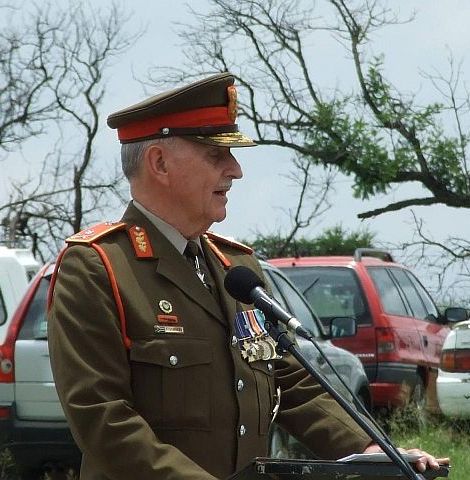
Deon addressing an Army event
Deon was born in Johannesburg in 1932 but for his early years he was very much a country boy as his father’s career as a mining commissioner took him around the country. From Johannesburg the family moved to Sabie and then to Lichtenburg and eventually to Pietersburg. It was at Pietersburg High School that the young Fourie first encountered men, well boys really, in uniform. His enthusiasm was fired immediately.
But a career in the then Union Defence Force (UDF), as it went through a painful period following the change of government in 1948, was not his (and perhaps more so, not his father’s) first choice. He joined the civil service in Pietersburg and then went to the University of Natal where he studied social science, graduating in 1953. From there he registered at the University of the Witwatersrand for a further degree. His interest in foreign affairs had been aroused and he joined the South African Diplomatic Service after having passed its entrance exam.
But after two years of rather unfulfilling work, he moved into the legal world of trademarks and patents but that too left him uninspired. It was then that the University of South Africa beckoned and this was to be the start of his academic career in 1968 as a lecturer in public administration. In 1973 he introduced strategic studies as an academic discipline at honours level – the first such programme in South Africa. He then became Professor of Strategic Studies at Unisa until his retirement in 1997. His expertise in this field earned him an international reputation and, in 1977, he was invited to advise on the formation of a strategic studies course at the NATO Defence College in Rome. He also ran courses at the Bundeswehr University in Munich as well as at the military colleges in Chile, Argentina and even in the USA. Needless to say, the SADF and the SANDF Staff Colleges across all the armed services used him frequently as a guest lecturer to senior officers attending Staff courses.
Throughout this period active soldiering was running in parallel with these various academic and other pursuits and the life of an officer in the armoured corps had provided the young Captain Fourie with many challenging moments as South Africa entered the unsettling phase of its history following the Sharpeville massacre in March 1960 and the ensuing rise in unrest across the country. In 1975 Major Deon Fourie assumed command of the Pretoria Regiment in the rank of Commandant (Lt Col today). He served in this role until retiring in 1980. He then immediately became involved in its Regimental Association and continued to serve it for the rest of his life. He and the commanding officer of the renamed Pretoria Armour Regiment worked closely together in restructuring what had been a famous South African regiment dating from 1913 to reflect the developments that had taken place in South Africa following the ANC’s succession to power in 1994. Deon Fourie and Lt Col Chabalala (the fifth CO since Deon's retirement) established a very strong bond.
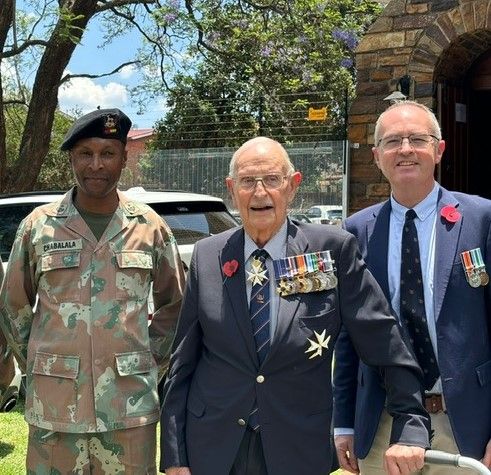
Lt Col Chabalala, Deon and his son Gideon
In 1987 Colonel Deon Fourie, soon to be promoted to Brigadier General, was appointed Director of Citizen Force Liaison on the General Staff of the SANDF. In this role he advised on Citizen Force policy and training while also maintaining close ties with the various CF formations around the country. His was a key role in assuring that the Reserve Forces were given adequate facilities as well as being accorded full recognition within the sometimes-rarefied world of the senior command structure of the SANDF. He retired from this position in 2007.
A peripheral interest of Deon’s was heraldry and particularly its military connotation. After South Africa’s significant change of political direction in 1994, and the ascendency of a completely new senior command structure within the SANDF, it was felt that the country’s heraldic symbols and artefacts must reflect the country as it had become. Between 1995 and 1997 Deon Fourie chaired the South African Heraldic Council and helped shape the honours now worn by members of the SANDF.
A man of boundless energy, he was very active in cultural and civic life. He chaired both the council of the South African Museum of Military History as well as the Pretoria branch of the South African Institute of International Affairs. He also served on numerous other governing bodies and councils. His crowning glory came when he was appointed a Bailiff Grand Cross of the Order of St John in 2021 having served this famous Order of Chivalry for forty years.
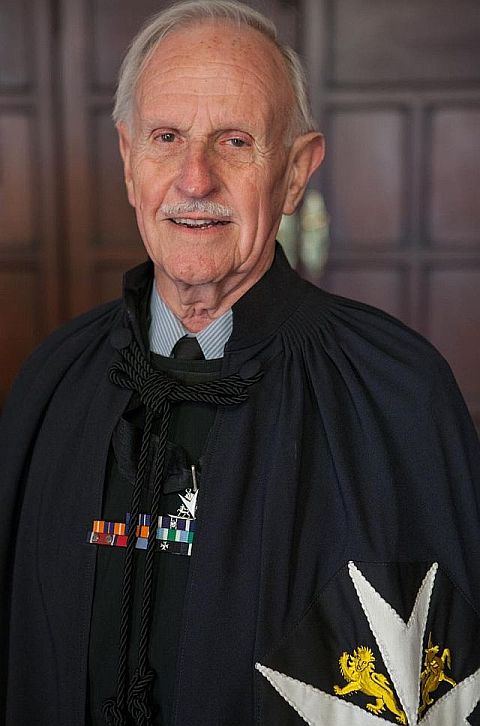
Deon wearing his robes and insignia as
a Knight of the Order of St John,
photo
taken in August 2013. He was elevated
to Bailiff Grand Cross in 2021
Deon Fourie was a regular contributor to this Journal with his last article appearing in the issue just prior to this one.
Written by Dr Brian Austin (9/11/2025) based on information (and photographs) provided by Deon’s son Gideon, and his daughter Helen.
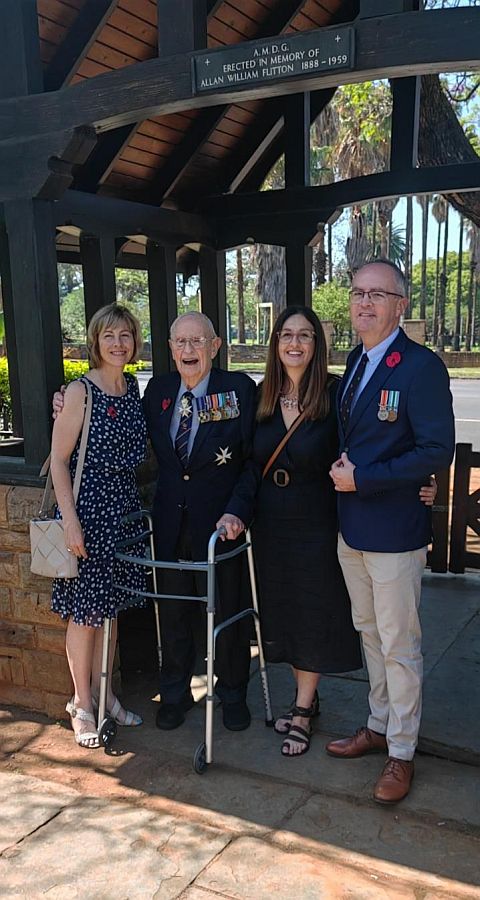
Deon with his children
Additional information from Joan Marsh:
Deon joined the SA Military History Society in 1986 and took out Life membership in 1992. He drove from Pretoria to the meetings at the Military History Museum in Johannesburg for many years, and represented the Society’s interests at the Museum’s council.
He proposed the toast to the Society at its 40th Anniversary function in 2006 and again at the 50th Anniversary in 2016, the text of this latter toast being included on the Society’s website.
After Covid-19 in 2000 the Society opted to hold three Zoom lecture evenings a month and Deon was a regular participant in many of these. Deon Fourie was a regular contributor to this Journal with his last article appearing in the issue just prior to this one.
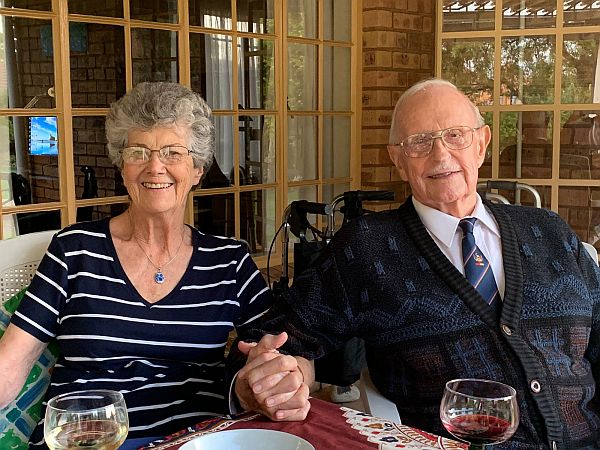
Deon and Felicia Fourie
His wife, Felicia, an excellent Tour Guide for several SAMHS trips, passed away a few years ago and he is survived by 2 daughters and a son and their children.
Return to Journal Index OR Society's Home page
South African Military History Society / scribe@samilitaryhistory.org