
 The South African
Kimberley, by February 1900, had been besieged by the Boer force under the command of General P.A. Cronjé for more than four months. Kimberley would have been a prize worth having - the centre of the diamond mining industry and the principal source of the wealth of Cecil John Rhodes. It was a thriving city, the mining industry having been the impetus for considerable industrial and commercial development. Kimberley was the third largest city in the Cape Colony.
The vulnerability to attack was obvious and the lack of a plan to defend Kimberley was cause for considerable concern in the military.
However, the politicians of the Cape Assembly were sceptical of any threat to the city, even though it was bounded on the east by the Orange Free State and the north by the Transvaal.
Several times military officers were sent to report on Kimberley's defences only for their recommendations and advice to be ignored by successive Cape Government administrations. But the breakdown of the conference between President Kruger and Sir Alfred Milner in Bloemfontein in July brought home the urgency of the matter of Kimberley's defences.
Milner persuaded the Cape authorities to send a thousand Lee-Metford rifles and some ammunition to Kimberley. Certain units of the Cape Police were detailed to guard important points around the city. In addition, in September, he suggested to Lieutenant- General Sir F. Forestier-Walker, now in command of British force in the Cape and Natal that a senior regular officer be sent to report on the defences. Thus the 45-year old Lieutenant Robert Kekewich of the Loyal North Lancashire Regiment arrived in Kimberley on 13 September. He was not in uniform as his arrival was supposed to be secret. It was an open secret as a little time previously another regular officer, Colonel Robert Baden-Powell, had passed through Kimberley and was then in command in Mafeking.
Kekewich was instructed to report directly to Milner and his first briefings showed that there were no regular troops in Kimberley and that there were no fortifications at all. Boer movements over the border indicated that mobilisation had begun and that Kimberley was seriously threatened. Local volunteers were only 540 strong with the artillery even fewer.
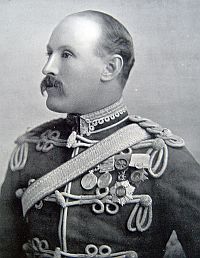
Lieutenant-Colonel
Robert George Kekewich
Kekewich immediately telegraphed for urgent reinforce ments and by 20 September received four companies of his own regiment, together with some artillery, engineers and medical staff. A call for local volunteers saw 2,000 enrolled within days.
The Boer ultimatum ran out on 11 October and hostilities began immediately with Boer incursion into the two British territories of Cape and Natal Colonies. Cecil Rhodes arrived in Kimberley on 11 October, clearly he had changed his mind about the likelihood of war as he had long been proclaiming that Kruger would 'bluff up to the cannon's mouth.' In other words, war was unlikely. The Mayor had warned him not to come, telling him that his presence would 'induce a rush with view to do the town, your Company and all our joint interests great damage'.
But Kimberley was where he had worked for more than twenty years to build De Beers Consolidated Mines which was still the main source of his wealth. With the city being threatened, it was natural that he should take his place with the citizens. His presence caused a great deal of controversy but he did put the resources of the De Beers company at the disposal of the British army. When he arrived in Kimberley there were considerable numbers of refugees and people with no homes or resources. He immediately agreed to employ them all to repair the neglected parks and roads. Later, when the Boers began to bombard Kimberley with their 6-inch Creusot gun, he provided shelter for considerable numbers of women and children down the De Beers mine.
Kimberley besieged was under martial law which meant that Lt-Col. Kekewich was the ultimate authority. Rhodes apparently had a long-standing contempt for army officers and had no intention of being bound by the dictates of the military. He sent numbers of messages out of the town in plain language and unencoded, several of which were intercepted, and others reached various Cape politicians. Although the telegraph lines had been cut and the rail line damaged, it was not difficult for runners to evade the Boer's loose cordon. The reply to a request sent to Cape Town by Rhodes asking for more guns was handed to Kekewich and found to be addressed to Rhodes. This put Kekewich in a difficult position. Rhodes was a powerful man whose cooperation was vital. Kekewich tried to win Rhodes over but the result was a row at the Kimberley Club, Kekewich's headquarters. Kekewich remained calm throughout as Rhodes, in a towering rage, insisted that he would allow no interference to his communications with the outside world and stormed out of the office. Thus began a long- standing feud between the two men.
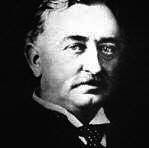
Cecil John Rhodes
This is not the place to describe the nearly four months of the siege. However, by the end of January 1900, Rhodes was becoming increasingly irritated by the fact that Field Marshal Lord Roberts and his army had been within about twenty miles of Kimberley for more than two months, yet Kimberley was still not relieved.
Instigated by Rhodes, an editorial appeared in the local newspaper, the Diamond Fields Advertiser, attacking the military command. Kekewich, not unnaturally, had been highly incensed, informing the editor that in future everything would have to be censored.
That same afternoon there was another stormy meeting with Kekewich. Rhodes demanded to be allowed to call a public meeting protesting the actions of the military which Kekewich naturally would not permit. Rhodes also demanded to be informed of Robert's plans for the relief of Kimberley. This also was not permitted. Bypassing the newspaper, Rhodes consulted a number of leading citizens and drew up a strongly- worded message to be sent to Lord Roberts.
'Your troops have been for more than two months within a distance of a little more than twenty miles from Kimberley ... a population of 45,000 has been enduring great hardships... the enemy has brought into action a gun throwing a 100-pound shell which is setting fire to our buildings and daily causing death among the population ... it is absolutely essential that immediate relief should be afforded to this place'.
A coded and condensed version was sent to Lord Roberts. Coming from a civilian it was extremely high- handed and impertinent. The Commander- in-Chief replied almost immediately, clearly not impressed by Rhodes or his demands. He informed Kekewich that any person, no matter how influential, who threatened to interfere with the military should be placed under arrest. He urged the town to hold on a little longer.
A few days later, Major-General John French ordered a cavalry advance across the plain to the east of Kimberley. In a remarkable exploit, the British lost very few men but their exhausted horses took a lot of strain. They reached Abon's Dam where there was water but inadequate quantities for both men and beasts. The following morning they entered Kimberley without Boer opposition, the Boers mostly retreating northwards or eastwards to join Cronjé, vacating the defences of Magersfontein and heading towards Paardeberg.
Kekewich was not in Kimberley that morning. The Boers were clearly retreating and he set out to capture the Boer Long Tom Creusot gun which had caused such panic among the citizenry. Kekewich.s men narrowly missed capturing the gun and their commander returned to Kimberley to meet up with French who, on arrival had been taken to see Cecil Rhodes. Kekewich arrived at the Sanatorium, Rhodes.s residence, to receive another outburst, reported in a London newspaper, 'You shan't see French, this is my house, get out of it! But Kekewich met with French in a private room. Many of the horses of the cavalry division needed care and feeding and cavalry Colonel Porter was ordered to attend to their rehabilitation, possibly as many as 400 of them. A good many of the horses in Kimberley were pressed in as replacements. Kekewich remained in command of the garrison. Colonel Porter, beyond the normal courtesies of rank, would have had no say in the garrison.s activities.
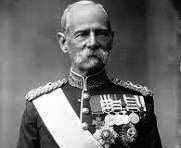
Field Marshal Lord Frederick Roberts
On 17 March, Lord Roberts and his Chief-of-Staff, Major General Lord Kitchener arrived in Kimberley. Rhodes had already gone, hastening back to Cape Town. Did Roberts and Rhodes ever meet? What would Rhodes have said to the man who had ordered his arrest? Rhodes was not a man who would easily forget such an incident. He almost certainly knew that the Commander-in-Chief had been aware of his highly critical attitude of the defenders and relievers. Kekewich did not see fit to arrest him but he must have been aware of Roberts's signal.
Probably the only time they could have come face-to-face was in Cape Town in December 1900. Lord Roberts was in town for a couple of days while on his way back to London to take up his appointment as commander- in-chief of the British Army. Rhodes was not well at that time, his heart condition undoubtedly aggravated with his experiences during the Kimberley siege. Certainly, there is no record that they ever met.
Bibliography
Brian Roberts - Kimberley: Turbulent City, David Philip Publisher, Cape Town 1976.
Major General Sir Frederick Maurice - History of the War in South Africa 1899-1902 Vol II, Hurst and Blackett Limited, London 1907
Thomas Pakenham - The Boer War, Weidenfeld and Nicholson, London 1979.
NOTES
1 Maurice History of the War in South Africa VII. On p63 is message from Lord Methuen to Kekewich: 'I am arranging military defence with you, and Rhodes must understand that he has no voice in the matter'. The official history devotes five chapter to operations around Kimberley but, in accordance with the dictates of the British government, scrupulously avoids anything of a political nature.
2 Roberts Kimberley: Turbulent City Chapters 19 and 20 has detailed account of Kimberley during the siege. The Commander-in-Chief's reply to Rhodes is on p330.
3 Packenham The Boer War pp321-330 has an account of the siege with much detail of the 'Siege within the Siege', the conflict between Rhodes and Kekewich. However, he seems to have taken Rhodes'.s side in the argument, quoting from an account that appeared in a London journal of Rhodes's meeting with John French. He also wrongly states that Kekewich was replaced as commander of the garrison by Colonel T.C. Porter, one of French.s cavalry brigade commanders. Far from being removed from command, Kekewich was promoted Colonel a few days later by Roberts, inclear recognition of his military performance as defender and his tactful handling of Rhodes. Misunderstood, too, is the command structure of the various army officers concerned.
About the Author
Robin, a published author, is a sub-editor and frequent contributor to the Journal. His first article appeared in 2004, with this being his twenty-second contribution, many being about the Anglo-Boer War.
His end-of-year newsletters, including many book reviews, are also to be found on the Society's website.
He lives in Howick, KZN
Return to Journal Index OR Society's Home page
South African Military History Society / scribe@samilitaryhistory.org