
 The South African
Introduction
The more memorable songs associated with various military campaigns and wars offer far more than pleasant listening decades after those conflicts. They allow to us to stand in the boots of the countless soldiers who lifted their own morale and sense of camaraderie by belting out these songs, usually off-key. They would do this while on the march, performing chores, relaxing together when off duty after hours - anywhere away from the combat zone. Technology added an extra dimension from the time of World War Two, when radio, gramophone and canteen Tannoy allowed the troops to hear professional entertainers rendering the songs of the day.
But there is more to these wartime songs than the diversion they provided for the servicemen. The lyrics of many of these songs often repay careful study for one reason or another: they can reflect the troops' attitudes to the personalities and events of the campaign; give particularly graphic and vivid descriptions of military action; or they can bring out the intensity of emotion felt by non-professional soldiers, volunteers only for the duration. In this article I look at a selection of such lyrics from songs popular during World War Two.
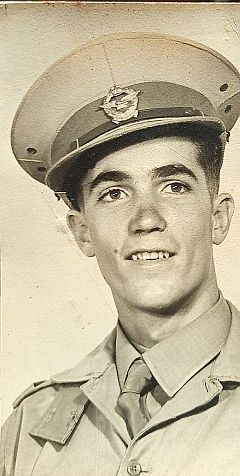
First, though, a brief word on my own extensive exposure to many of these songs. These took me back to the days of my youth, for a 33 rpm LP, "The Songs They Sang Through Two World Wars", played constantly in my childhood home (between Beethoven, Mozart and Broadway musicals). More than that: my father, a World War Two SAAF veteran, would often burst out with these wartime songs, including some that weren't on the LP (for good reason in one particular case, as I'll mention later).
Lili Marlene
Perhaps the most popular song of WW2, 'Lili Marlene' (sometimes spelt Marleen), is really a rather saccharine love ballad, originally a poem directed by a German infantryman to the girl of whom he sees all too little. She's addressed by both her first names (unless you believe that such a romantic ditty could involve two- timing two different girls!).
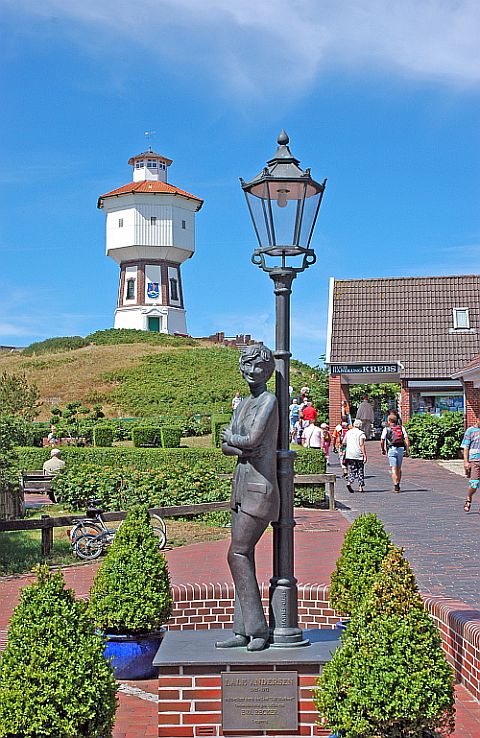
What made 'Lili Marlene' an international hit, transcending the conflict, was that the Allies in North Africa -attracted by the universal theme as well as the catchy melody simply appropriated the song from the Afrika Korps. An 'official' English translation was done by a bilingual British officer and first performed by the popular singer Anne Shelton.
However, the iconic actress- singer Marlene Dietrich ("Germany's greatest gift to Hollywood") would later use her own translation, somewhat closer to the idiom of the German original. Though her words contained nothing suggestive, Dietrich'.s rendering of the love ballad predictably sounded more sultry and steamy than those of Andersen in German or Shelton in English.
But it is the alternative lyrics to 'Lili Marlene' invented by the Eighth Army, who came to consider the song almost their own property despite its origin, that are the most arresting today. I'll mention a verse that my father often came out with - which I have never been able to find anywhere online or in print. Yet, although he was serving with the SAAF in Egypt, he could only have acquired it from contact with the British Eighth Army, because it neatly sums up their campaigns from 1941 to 1945 (flanked by South African and other Commonwealth units) in the space of fourlines:
The most memorable Eighth Army version, however, was the force's infuriated musical response to an alleged speech by Lady Nancy Astor in late 1944. She's said to have dubbed them 'the D-Day Dodgers', accusing them of 'skiving off' in Italy amid the sun, vino and signorinas, while the real fighting was happening in France. (Lady Astor denied ever making such a speech; my father said there were British soldiers in Egypt who swore that she had. Her increasingly wild prejudices make the event more than possible.)
If she really made such allegations, they were of course absurd and ignorant nonsense; the Eighth Army had taken part in some of the most vicious and bloody battles of the entire war as they fought their way up the Italian Peninsula. They emphasised these facts with furious sarcasm in their musical riposte to Lady Astor, set to the tune of 'their' song, 'Lili Marlene'. It's called 'The D-Day Dodgers' and the lyrics are well preserved, even though the Eighth Army's version was probably never formally recorded (until the group The Spinners did it as late as 1973). The lyrics refer to such bitterly contested battles in Italy as the Anzio and Salerno landings, Cassino and the Gothic Line in general. They suggest with searing sarcasm that (on Lady Astor's alleged interpretation) the Eighth Army had only gone to these places 'for the ride' and 'to look for dames'. The verse directed at Lady Astor herself (a popular philanthropist and socialite), is unsparingly personal in its retaliation for her slurs:
Colonel Bogey
After the tune of 'Lili Marlene', the next most popular air among British and Commonwealth troops in WW2 was probably the Colonel Bogey march. This was composed as a march, very easy to whistle. But it's also so easy to set lyrics to the tune, from its two-beat opening bar onwards, that this inevitably happened. The lyrics ranged from elevated topics like 'Duty!' to bawdy inventions - reaching their bawdiest during World War Two.
Soldiers down the ages have tended to deride their enemies' chief commanders, sometimes in the most basic terms. This happened in an extreme way with a ditty to the tune of 'Colonel Bogey' about the four top Nazi leaders that became very popular with Allied troops. Modesty has precluded printing the ditty in the past, but by this stage of the 21st century readers will probably not be offended - especially if they themselves once sang the words with gusto. There are variants, but my father's version (which my mother tried to discourage him from singing while we children were still very young and impressionable) went:
No wonder that in post-war reminiscing, it was whistled more often than it was sung! A memorable scene in the 1957 film Bridge over the River Kwai has well-fed extras in the role of Allied POW's, dressed in still intact uniforms, whistling Colonel Bogey as they march to another day's work on Japan's infamous Death Railway.
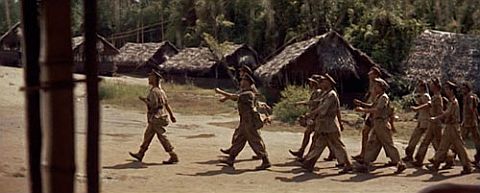
In reality, of course, the emaciated, ragged, abused, disease-ridden prisoners would have saved what little breath and energy they had for the hours of virtual slave labour that awaited them.
It's unclear who Colonel Bogey was, how he came to be associated with the famous march and even if he was a real person. There is a tradition that away from his military duties, he was an avid golfer and gave his name to the term 'bogey' for a score of one over par for a particular hole. No solid confirmation or evidence appears to exist for any of this, even though 'bogey' is still a standard term in golf.
Vera Lynn and 'The White Cliffs’
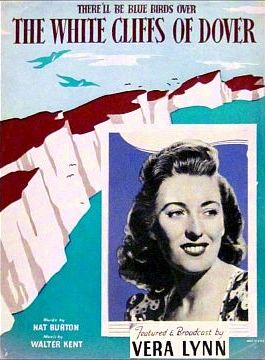
From the ridiculous to the sublime. The White Cliffs of Dover wasn't a song that troops could render in cheerful chorus; it's too complicated in its chords and arrangements for anyone but a professional singer to do it justice. And what a singer we had! The song is forever associated with Vera Lynn, "The Forces' Sweetheart" whose morale-boosting effects on Allied soldiers helped to win the war. On the occasion of Dame Vera's 100th birthday in 2017, her image was memorably projected onto the White Cliffs at night.
The song could not have chosen a more iconic symbol than the White Cliffs of Dover for the defiant spirit that gripped Britain during the darkest hour in 1940. The cliffs stood like a bulwark at the island's closest point to a hostile continent, from which invasion seemed to be imminent. Vera Lynn's song couples the timeless White Cliffs with equally symbolic images of bluebirds flying over them, along with the shepherd tending his sheep just inland, the valley blooming and a little boy sleeping safely in his own bed (not evacuated because of the Blitz) - created the vision of a peaceful future that must have seemed infinitely far off in 1940.
Ornithologists have pointed out that there will never be "bluebirds over the white cliffs of Dover", as the attractive small bird is found only inNorth America. This is the only part ofthe song that betrays its surprising transatlantic origin: two Americans, Walter Kent (apt surname for Dover) and Nat Burton, respectively wrote the music and the lyrics, which show an astonishing degree of empathy for Britain's plight in 1940. However, the bluebirds were of course just as symbolic as the physical White Cliffs in the song: the Bluebird of Happiness had been a part of many cultures for millennia and had been celebrated in a hit song by the American tenor JanPeerce as 'recently' as 1934.
Did the song arouse the same kind of profound sentiment in Commonwealth troops, very few of whom had ever seen the White Cliffs or any part of England? My father came from the then very Anglophile city of Durban (later dubbed 'The Last Outpostof the British Empire'), so he could relate to an extent. But he told me a revealing story. He was lucky enough to attend a concert for the troops given in Cairo by Vera Lynn herself. He said that the tears in the eyes of the tough Eighth Army men when she sang 'The White Cliffs', were enough to trigger sympathetic reactions even from their hard-bitten South African, Australian and New Zealand comrades seated in packed rows alongside them.
Flanagan and Allen
A very different impact was made slightly earlier in the war by the singer-songwriting duo Flanagan and Allen.
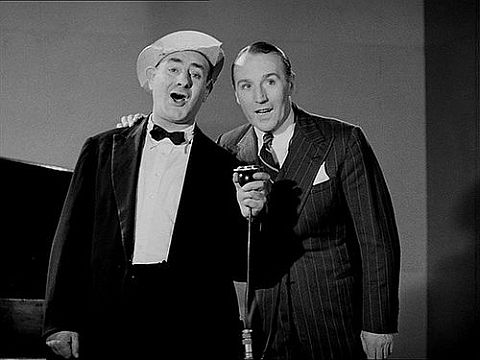
As a second British Expeditionary Force (BEF) in 26 years prepared to embark for France, Flanagan and Allen encouraged them with the extreme optimism of "We're going to hang out the washing on the Siegfried Line", airily dismissive of Germany.s Wehrmacht and its main defensive line. It was first published in 1939, penned (Wikipedia says) by an Irish songwriter and Captain in the BEF: Jimmy Kennedy. Michael Carr composed the tune. Flanagan compounded this hyper-optimism with a parody of the duo's Run, Rabbit, Run (a jaunty bucolic ditty about a farmer hunting an elusive rabbit), adapting it to "Run, Adolf, Run".
My father told me about a sardonic but apt new interpretation of the latter song that emerged as the BEF, far from tackling the Siegfried Line, were routed and forced back with their allies to the French coast. It was the BEF, so went this interpretation, who were 'running like rabbits' from the juggernaut Wehrmacht 'farmer'. But most of the BEF managed to escape from Dunkirk, thus heeding the song's injunction, "Don’t give the farmer his fun, fun, fun". Bud Flanagan and Chesney Allen must have been aware of this interpretation, perhaps even encouraging it as the most face-saving way to match the actual outcome to the initial patriotic optimism of their songs.
A Wing and a Prayer
The United States was an even more fertile source of WW2 songs and singers than Britain. As an airman, my father was profoundly moved by Harold Adamson and Jimmy McHugh's inspired song Comin' in on a Wing and a Prayer, about a flak-stricken USAF bomber limping back on three engines from a successful raid over Germany. So was practically everybody else who listened to the words. It's hard to think of anything more evocative of a real war situation than what the bomber's "gallant crew" were imagined as telling their base by radio, in part as follows:
Testimony to the power of these lyrics was borne out by the fact that 'on a wing and a prayer' almost immediately became a proverbial saying in English for any marginal, nerve-racking exercise; it's still heard occasionally even today.
The Lady in White
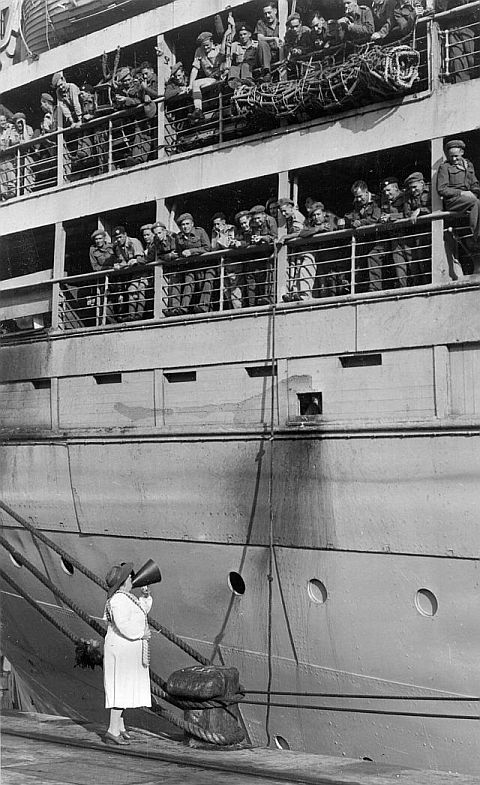
Finally, South Africa's contribution to the music of World War Two. Durban's 'Woman in White' played as important a role in her way as any singer of the war. Perla Siedle Gibson, a classical soprano, would come down to the docks, always clad in white, whenever a troopship berthed there. She would use a megaphone to entertain those on board with hits of the day (no doubt including the above) as well as more formal fare. It's said that the soldiers all flocking to one side of the ship to hear her, often caused it to list visibly to one side.
USA
America's very national anthem is linked to a war, The Star-Spangled Banner, celebrates how the Stars and Stripes were still flying at dawn over a fort that had been battered by British shellfire all night during the War of 1812. Two other songs have especially vivid backgrounds in US conflicts. John Brown's Body was originally about the death of an abolitionist in the bitter debate over slavery that eventually became a defining theme of the American Civil War. Its tune was later borrowed for, inter alia, the song about the Parasergeant-major who "jumped 20,000feet without a parachute", still popular when MHS members were doing their national service.
The Yellow Rose of Texas has its roots in the iconic fall of the Alamo, during the Texan Revolution against Mexican rule; but its jaunty melody was used with many other lyrics, most notably by exhausted Confederate soldiers singing wearily about their generals, especially "the gallant Hood of Texas, he played hell in Tennessee".
Conclusion
Millions of ordinary men and women were plucked from civilian life to become temporary soldiers during World War 2. For providing the moral and psychological boost that these part-time soldiers needed to get through six years of conflict, songs of the time were of incalculable, even indispensable value.
These few samples show clearly how rich in military-historical context many of these songs are. That is why - apart from the sheer enjoyment they still afford - they are worth the effort of preserving and reflecting on their significance.
About the author While still living in Gauteng, Nick presented two sing-along programmes at the Johannesburg meetings then held at the Ditsong Museum. In October 2014 his subject was Songs of WWI, followed in May 2017 by Songs of WWII. Song-sheets were handed to attendees and a cheerful noise was made by all, greatly helped by his musician friends of all ages.
These days Nick, a retired SABC News reporter, contributes to the Eastern Cape (SAMHSEC) Branch outings and lectures.
Return to Journal Index OR Society's Home page
South African Military History Society / scribe@samilitaryhistory.org