
 The South African
Unsung Heroines& Heroes
Those South Africans who served on the front line, especially those who made the ultimate sacrifice, will always be remembered and thanked for their dedication and service.
However, this year, on the 80th anniversary of VE Day, the SA Legion (a century-old military veterans organisation) decided to celebrate particularly those non-combatants who, while just "doing their bit", quietly played essential roles contributing to the Allied victories in 1945. Many combatants, especially stretcher bearers, had dramatic experiences rescuing wounded soldiers and some received MMs or DCMs for it. They have, perhaps, been too often overlooked.
The Legion thus organised an exhibition along these lines at the Military Museum at the Castle of Good Hope. Originally intended to run for only three days, culminating in a Memorial Day on Saturday 10th May, the Military Museum requested its duration be extended to at least the end of 2025.
Among the often-unsung heroes and heroines being celebrated are the25,000 women who volunteered to join the WADC (Women's Auxiliary Defence Corps) as non-combatants in the WAAF (Women's Auxiliary Air Force), WAAS (Women's Army Auxiliary Services), SWANS (South African Women's Auxiliary Naval Services, WAMPC (Women's Auxiliary Military Police Corps) and SAMNS (South African Military Nursing Service).(1)
Also honoured are the more than 123,000 men of colour who volunteered to enlist in the Cape Corps or Native Military Corps as non-combatant support staff, serving as stretcher bearers, drivers, guards, kitchen staff(2), as did over 63,300 civilian volunteers involved in the part-time units that included the Home Guard, Reserve Forces, Garrison Artillery, and more(3). Last but not least were the further 5,468 civilians from all communities, not strictly military but under discipline, engaged in guard duties as part of the Essential Services Protection Corps(4).
By 1943 there were collectively nearly 67,000 women serving as volunteers in women's auxiliary organisations: SAWAS - South African Women’s Auxiliary Services, CWWW - Cape Coloured Women War Workers and NWWW - Native Women War Workers)(5).
Between 1940 and 1947 they raised more than £1,811,000 for the National War Fund, charities, the National War Memorial Health Fund and more(6)
Thousands of other women worked in munitions and other factories as the men left to join up.(7)
A veritable army of civilians was involved in the war effort - a war that, by 1945, had claimed the lives of 73 million civilians and 24 million service members worldwide.
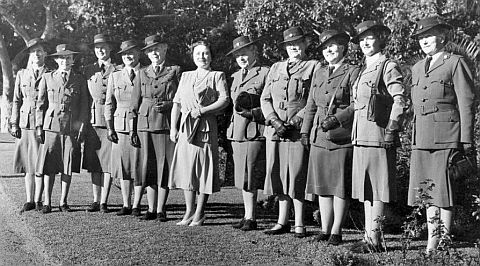
Elizabeth, Queen of King George VI and
later the Queen Mother, in East London
with 10 of the Provincial Commandants of SAWAS
during their Royal tour of
South Africa (1947).
Photo courtesy of Ivor Markman
Other unsung, but combatant, heroes are also celebrated in the exhibition, for example the 10,000 South African soldiers who enlisted for service from the Jewish community.(8) And individuals too: the teenage Wolmarans brothers, of whom one falsified his age in order to enlist at 17; the second forging his mother's signature.
Another such was the now 98 year old Guest of Honour, Joe Wilkinson (RN). He recounts his recollections in a 'living memories' video within the exhibition, along with - among others - those of Ian Campbell, another 98 year-old, and of Gurth Walton who sadly passed away in February 2025, at the age of 101.
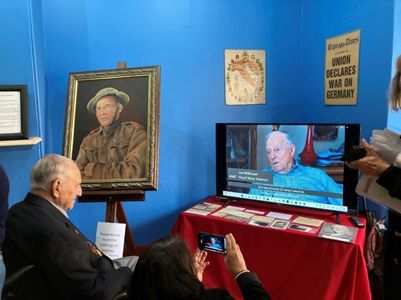
Joe Wilkinson (RN) (aged 98) watching
a video made in 2019, where he recounted
his enlistment as a 17-year-old teenager.
The Exhibition
In the background of the above photograph is a painting by one of the Castle's artists of L-Cpl Johannes Stevens*, whose citation awarding him the Military Medal (MM) appeared in the London Gazette of 9 September 1942.(9)
Stevens earned his MM for guiding a party of POWs safely, and on foot, through a minefield.
Footnote
*Stevens' story is told in Ian Gleeson's The Unknown Force: Black, Indian, and Coloured Soldiers Through Two World Wars. Ashanti Publishing, 1994
His story is part of a multimedia presentation set up in the Castle's Military museum that includes original artwork of 20-year-old Constable Hendrik Snell, a Civic Guard in the Claremont Civilian Protection Services (CPS) who received the King's Medal for bravery. Also featured are stories of the sacrifice, heroism, and resolve of servicemen Majozi, Maseko, Saphier, Melzer and others. On show are themed infographic posters, photographs, videos and World War II memorabilia.
The Naval Heritage Trust display included interesting memorabilia, as well as original uniforms typically worn by WADC women. S A Military History Society Honorary Life Member, Commander 'Mac' Bisset (Ret.), manned a stall where members of the public could find out more about their families' war medals and how to access veterans' military records.
And in the spirit of peace, the Exhibition featured a "Peace Wall" where visitors could write messages of peace, hope and fellowship. Many such messages, in multiple languages, were written there.
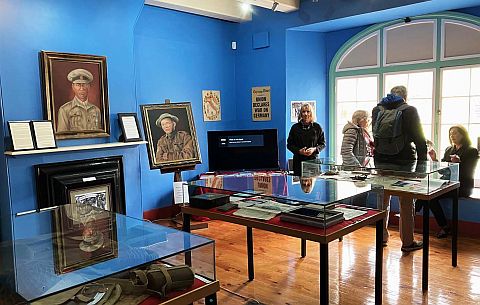
One of the exhibition rooms
with members of the public
speaking to curators
The VE Day Memorial Service &Celebrations 10th May 2025
Cape Town paid tribute to the unsung heroes of World War II at the Castle of Good Hope, beneath sombre clouds and in gentle rain.
Senior members of the armed forces, consular representatives (see box) and various veterans' associations laid wreaths, assisted by South African Sea Cadets based in Simon's Town.
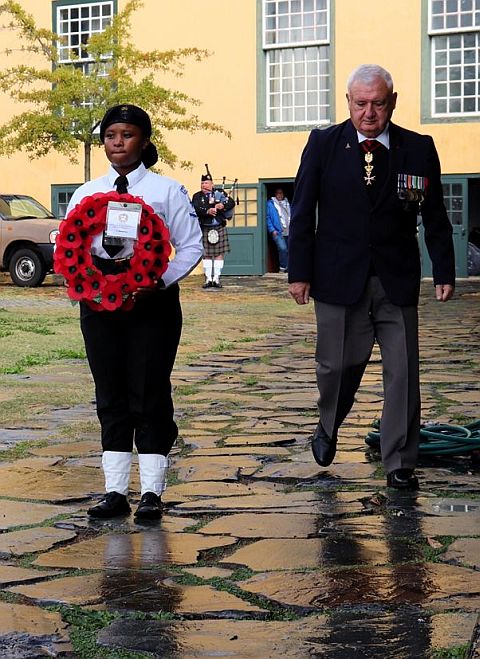
Sea cadets assisted with wreath-laying and ..
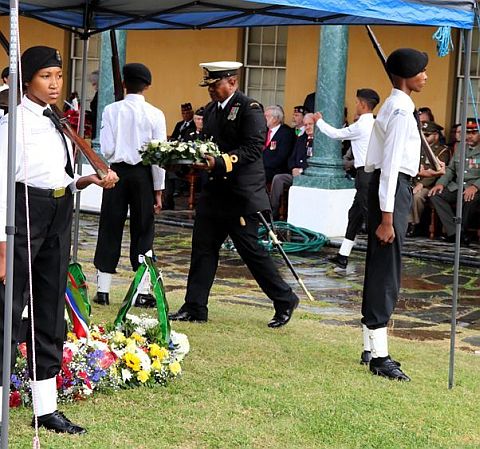
.. stood guard at the corners of the
gazebo
under which the wreaths were laid.
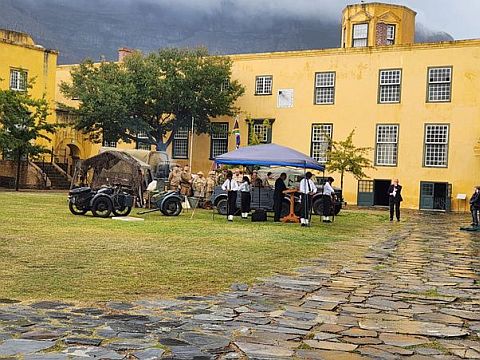
Alderman Ian Nielson, former Deputy Mayor
of the City of Cape Town,giving his address.
See Table Mountain
complete with table cloth in the
background!
Alderman Ian Nielson, from the City of Cape Town, delivered a poignant address in which he mentioned "More than 334,000 South African men and women from all walks of life answered the call to volunteer to fight in a war, far from their homeland.
They did not do so for conquest or glory but to uphold the values of freedom, human justice and dignity".
He went on to say: "South Africans fought with distinction acrosstheatres of war in East Africa, North Africa, the Middle East, Italy and beyond, particularly in battles such as El Alamein and Tobruk, that were fought in the harsh desert terrain ... when Tobruk fell nearly 10,000 South Africans were taken prisoner and spent 2 to 3 years in POW camps ...
"The South African Forces re-arranged as the 6th Armoured Division, and in 1944/45 served in the Italian Campaign. From the bitter winter battles of Monte Cassino to the liberation of Florence and beyond, South African soldiers stood firm, enduring gruelling conditions with resolve and determination. Their efforts in Italy helped pave the way to the ultimate surrender of the Axis Forces in Europe."
Nielson went on to say: "As we commemorate the contribution of South Africans, it's vital that we speak honestly and inclusively. For far too long the role of black South Africans, Coloured South Africans and Indian South Africans in World War II were overlooked or minimised. Though officially barred from combat roles, tens of thousands of non-white South Africans served in critical capacities."
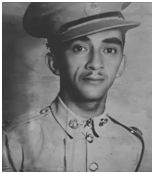
Sgt P J du Plessis
Cape Corps
Four SACS High School trumpeters played the Last Post and Reveille and the Cannon Association of South Africa fired two salvos from ceremonial cannons.
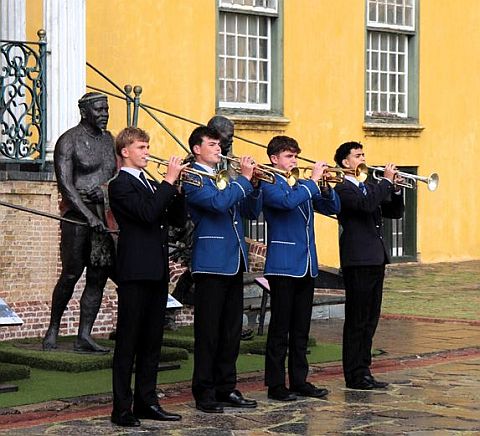
Trumpeters in front of a
statue in the
Castle courtyard
Musical tributes were also performed by the Pipes and Drums of Cape Garrison Artillery.
Learners belonging to the Brass Ensemble and Jazz Bands from Christel House South Africa played a hymn and the National Anthem, and after the service entertained with some jazz numbers.
Bringing history to life, Heritage Group Reenactment Society members in authentic WWII uniforms, both men and women, operated a Field Kitchen amidst a display of period- specific military vehicles.
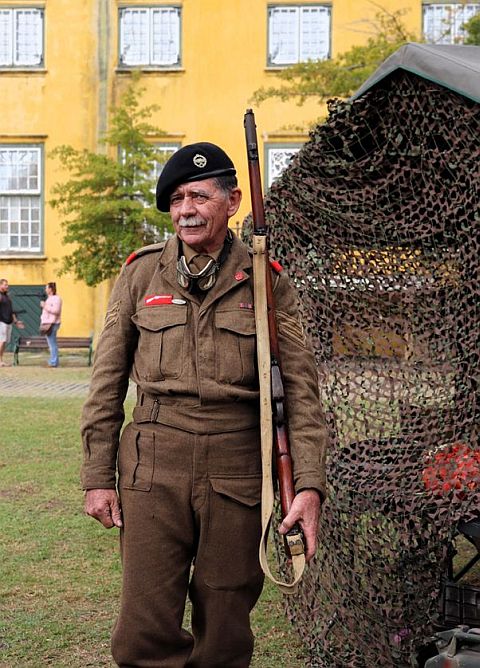
Uniform and weapons display
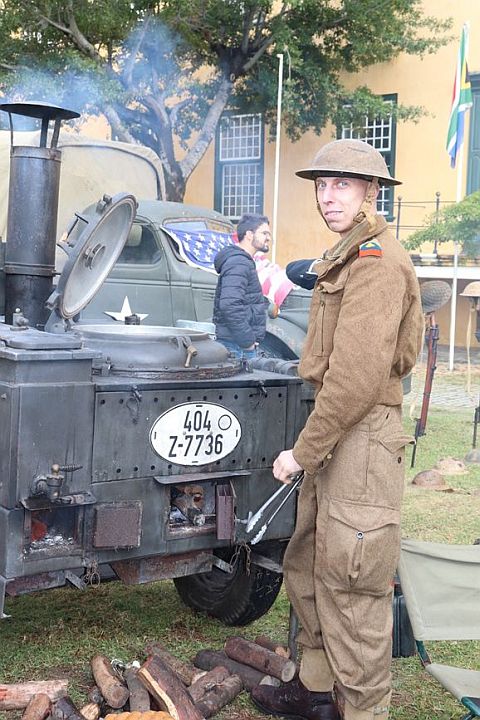
Field kitchen Display
Pipe Major Tony Reis
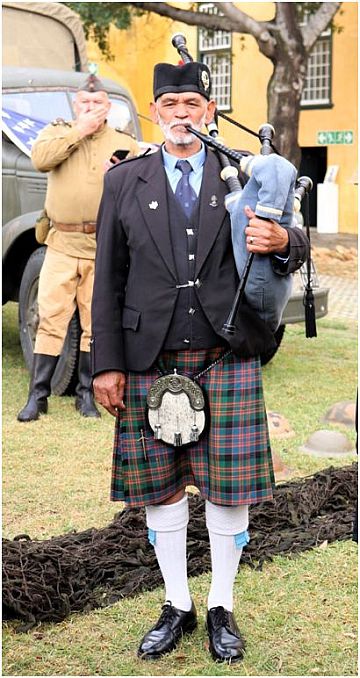
Piper M. Opperman
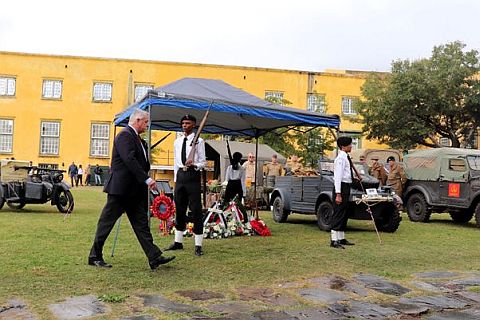
Wreath Laying Ceremony Kevin
Ashton, JCD
(SA Legion Chairman
– Cape Town Branch)
Summing up the day, Kevin Ashton JCD, Chairman of the SA Legion (Cape Town Branch) said: "The importance of continuing to mark the anniversary of this global event that had such a profound effect on modern history, is to remind us of the horrors of war and to value the sanctity of peace, lest we forget the former."
Diplomatic wreathlayers
Bibliography
(1) Official Union Office of Census and Statistics, 1948a.Union of South Africa Yearbook No. 23 of 1946. Government Printer, Pretoria, p.20.
(2) Markman, I., 2016. South African Women’s Auxiliary Services
(3) Kotzé, E.M., 2021. More than just pretty girls in uniform: A historical study of women's military roles during World War II, 1939-1945. PhD thesis, Stellenbosch University, p93.
(4) Mlambo, N., 2000. Arms production and war supply in Southern Africa 1939-1945: Limitations of the industrial war effort of South Africa and Zimbabwe during the Second World War. PhD thesis, University of Cape Town.
(5) Official Union Office of Census and Statistics, 1948b Union of South Africa Yearbook No. 23 of 1946. Government Printer, Pretoria, p.20.
(6) Ibid
(7) Ibid
(8) Van der Waag, I., 2020. Sights, Sounds, Memories: South African Soldier Experiences of the Second World War. African Military Studies, Volume 3. African Sun Media, p.3.
(9) Museum of the Jewish Soldier, n.d.South Africa.(Accessed 20 March 2025).
(10) Gleeson, I., 1994. The Unknown Force: Black, Indian and Coloured Soldiers Through Two World Wars. Ashanti Publishing.
About the Author
Marina Hall is a volunteer who coordinated the SA Legion's 80th VE Day Commemoration, spent over four months compiling 42 posters, creating 8 videos, and curating WWII photos and artifacts while drawing on contributions from various sources, both locally and overseas.
She also interviewed and filmed former SA Legion Chairman, Ian Campbell, aged 98, covering his wartime experiences. Jaco van Zyl, an artist/curator at the Castle, assisted with the exhibition installation.
Return to Journal Index OR Society's Home page
South African Military History Society / scribe@samilitaryhistory.org