
 The South African
Introduction
Part I traced the activities of Section 1, accompanying the main force from Cape Town to Pretoria, via Bloemfontein. Part II described the action of Section 2, bottled up in Ladysmith, and of its offshoot, the 'Extemporised Section', working to assist Buller's attempt to relieve the town. Here, the work of Section 3, the 'late arrival', is described.
BALLOON SECTION #3
When the war broke out in October 1899, only Sections 1 and 2 existed. Efforts were immediately made to form and train a further Section, and this became No. 3. Training took time, and hence the Section only arrived in South Africa on 30 March 1900. Thus its career, being briefer, is more easily traced. Under command of Major Blakeney, it followed in the footsteps of the main thrust as far as the Modder River, and then diverged, striking north to Warrenton, about 60 miles (roughly 100km) beyond Kimberley, on the bank of the wide, braided Vaal River. Here, on 21 April(2), it joined up with the 10th Division under General Hunter, part of Lord Methuen's command. Methuen's strategic task at this time was to guard the left flank of Roberts' advance on Pretoria; tactically, he was to relieve Mafeking.
To frustrate any further advance of this, the British left wing, the Boers had set up blocking positions at Fourteen Streams on the Vaal's north bank, facing Warrenton, and at Rooidam, on the river about eleven miles (18km) downstream to the west.
The Section inflated the 10,000 ft3 (283m3) Trumpet on 23 April and immediately began reporting on the Boer positions, both directly across the river and at Rooidam. (It is not clear whether the latter was observed from Warrenton, or - more likely - whether the balloon was moved downstream first.) Trench locations and troop movements were noted, but perhaps their most notable achievement was to spot the Boer laagers (base camps) some 4 miles (6,5km) back from the river. Ground observers had been quite unaware of their presence. Field pieces could not reach that far so a battery of longer- range 5-inch howitzers and a 6-inch piece railed up from the south were brought to bear. With Trumpet spotting and correcting their fall of shot they shelled the target heavily. When the guns were moved further forward and came within range of three Boer pieces the balloon was again of great service. For the Boer guns used smokeless powder, and being placed behind cover, were invisible to their British counterparts. But Trumpet, floating above the action, could see their muzzle flashes and was soon able to direct effective counter-battery fire.(3)
It's not clear whether communication was by telephone or megaphone, though Mead, quoting an unpublished RE paper(4) believes that No.3 Section had no telephone (though we should note that many accounts indicate very strongly that the other Sections, including Phillips' ad hoc unit on the Tugela, were so equipped). The method used for giving the guns the correct line of fire was to have one man positioned vertically below the balloon and a second some distance away in the rough direction of the target. The observer in the basket then instructs man #2 to move -left or right as appropriate until he is in line with the target. This gives the correct compass bearing which, corrected for the lateral distance between balloon and battery, can be passed to the guns.(5) One other notable feature of Trumpet's work was that, frequently, the observer in the basket was not a Section officer, but an artillery officer, Captain MacMunn.(6) This was an early example of that close co-operation between the two disciplines that would become, before long, a hallmark of the balloon service.
On 5 May the British crossed the river at Rooidam and turned the Boers out of their position there. From Rooidam, two days later, the British launched a flank attack on Fourteen Streams and obliged the Boers to abandon their entrenchments there too. Not least among their reasons for retreating was (by their own admission) the ability of the balloon, like an omnipotent eye in the sky, to bring down accurate fire at will on their positions.(7) The damage that had been wrought to their supplies, wagons, etc., in the laager, also thanks to the balloon, no doubt contributed to their sense of defencelessness.
Satisfying though this little victory(8) was to the British, it was really no more than a distraction to keep the main Boer forces in the area occupied while a flying column, under Colonel Mahon, rushed past the Boer right and made directly for Mafeking. Skilfully and energetically handled, it rode into Mafeking on 17 May. The last of the three great sieges was lifted.
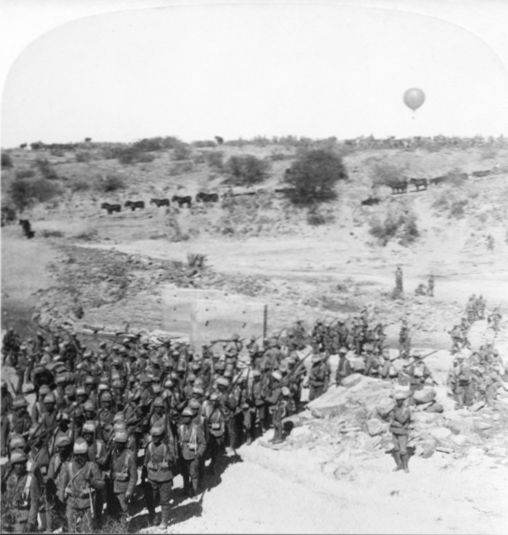
Fourteen Streams was Section 3's first, greatest, and last aerial operation. Two days after the Boers retreated, the Section deflated Trumpet, bringing to an end a remarkably productive unbroken fifteen-day stint, despite the difficulties of intermittent winds and the ever-present problem of achieving lift at a location already about 3,500ft (1,060m) above sea level. Once packed up, they were detached from Hunter's Division and sent south-west towards the small road-junction town of Boshoff, 37 miles (60km) away, in order to join up with Methuen's main force. Moving at ox-speed this took six days. When they arrived, they discovered the order had long since been rescinded and so retraced their slowly plodding steps.
By now well behind their former comrades they followed on at their best speed, heading first north to Vryburg, then eastwards towards Potchefstroom and Johannesburg. However, it was increasingly clear that balloons were going to be of no more immediate assistance to the army, whose advance was now virtually uncontested. Hence, once at Potchefstroom (they arrived in mid- June) Major Blakeney suggested his men could be better employed in reopening and running the Potch-Klerksdorp railway - they were, after all, well rounded Royal Engineers.(9)
This occupied them for just over two weeks, until Potchefstroom was no longer needed as a depot. From this point on they began to shed equipment and personnel to Section 1. The first reference to this in Section 1's Diary is on 9 July 1900, when two balloons and two loaded cylinder wagons were earmarked for transfer. Shortly afterwards, an officer and eight other ranks were transferred across, notionally on a temporary basis. But, in truth, by now there was little need to retain operational balloon units, and so - like Section 1 - after about four months spent on general RE field duties, Balloon Section 3 was officially dissolved.
Boer reactions to balloons
The balloon inconvenienced, annoyed, and offended the Boers. To remain concealed, movements of men and wagons had to be by night - difficult in rough terrain lacking distinctive features other than hills and valleys. Muzzle flashes gave away gun positions. The balloons were bad for Boer morale too. Not only was it an unfair means of waging war, but the individual's sense that he himself was being watched by the balloon was difficult to shake off. To quote one example, Dietlief van Warmelo recalled:
"When I went to look for my horse or to fetch water or wood, there it [the Ladysmith balloon] stood, high up in the sky, and I felt as if it kept its eye specially fixed on me, and as if I might expect a bomb at any moment".(10)
Similar impressions were recorded wherever balloons were employed.(11)
An equally wild belief was prevalent, even at the highest levels, that the balloons were aggressive engines of war:
[T]he notion ... had got into the heads of the Government at Pretoria, that while the Boers were advancing into Natal [from the Transvaal] the British would make a raid upon Pretoria in war balloons. Instructions were given to all telegraph stations to report any balloons seen, with the result that for the first fortnight balloons, singly or in coveys, and usually provided with powerful coloured searchlights, were daily reported from every quarter of the Transvaal.(12)
How did the Boers imagine the British would be able to steer their war balloons from far away and on to Pretoria without obvious means of either propulsion or guidance? Far- well softens the implied ridicule somewhat by suggesting the Boers may have been anticipating airship rather than balloon attacks.(13)
One other wild belief which had spread, widely it seems, among some Boer units was that Cecil Rhodes, trapped and fulminating in Kimberley, was planning to disguise himself as a woman and escape that place in a balloon!(14)
The presence of a balloon tended to neutralize one of the Boers strongsuits: to find concealment within the veld they knew so well. More subtly, the balloon engendered a sense of technological inferiority among the Boers. This was brought out in an oft-quoted lecture(15) given in Paris by Arthur Lynch(16) in which he reflected on the performance of the British balloons, a reflection which on the whole was highly complimentary. (This, despite Lynch being - at this time at least - no friend of the British, having fought against them in the Boers' Irish Brigade.) He pointed out that the Boers could match the British in most technological aspects - guns, rifles, shells, telegraphs, heliographs etc. - but had nothing to match their aerial resource. (They were offered a man-lifting kite at one point, but the initial demonstration went wrong and they immediately lost interest in the proposal.(17) The 'ungodliness' of attempting to fly may not have been an irrelevant factor.)
Lessons of the War
Lessons had been learned. In regions of heat, dryness, sand and high winds balloons were very vulnerable and a high wastage rate could be expected if care was not taken (and even when it was, ill luck could still negate the greatest care).(18) In the case of goldbeaters. skin balloons, frequent treatment to keep the fabric supple helped - witness the lengthy unbroken inflations at Warrenton (Section 3) and on the march to Pretoria (Section 1).
One method of keeping the balloons safer was to deflate them whenever strong winds threatened. This necessitated a ready re-supply of gas which, given the weight of gas cylinders, posed its own logistic problems. The balloonists relied quite heavily on railways being available to bring the supply well forward. Then it was wagons and oxen (or horses, if conditions were appropriate). The constant begging and borrowing (and enforced handing back) that had to go on to obtain the necessary teams made it clear some more regularised system would be needed in any future campaign.
One difficulty all Sections encountered was getting enough lift out of their fairly small 10,000ft3 (285m3)balloons when they were stationed several thousand feet above sea level. (The whole route from Bloemfontein to Pretoria lies above the 4,000ft (1,200m) contour; the land round Magersfontein and Modder River is in the region of 3,600ft (1,100m), and in the Tugela Valley in front of Ladysmith, and in Ladysmith itself, the balloons would have been operating from a base between 3,300 and 3,600ft(1,000-1,100m) above sea level.) The failure to anticipate the possibility of operations at higher altitudes appears to be a curious lapse on the part of Colonel Templer (the balloon service's early advocate, midwife, and - for a time - its chief). Perhaps he feared the extra cost of larger balloons would cause the parsimonious War Office to back off the idea of balloons entirely? Experience could not be denied, however, and it was not long before 13,000ft3 (370m3) balloons became a standard size within the Sections' inventory. Presumably to keep in step with the increased lift anticipated, longer cables of 4,000ft(1,220m) were also soon adopted.(19)
Communication is and always has been a key element on any battlefield. The balloonists soon discovered that the basket-to-ground telephone was really the only choice: flag signalling had proved its weakness at Paardeberg, when gunners were too busy serving their guns to read every message flagged from the basket.
Lastly, a point long appreciated was once again driven home: balloons were unsuited to help in highly mobile, small unit actions such as the South African war soon evolved into. Although the difficulties they had to confront in hilly country were also demonstrated, there was no better option available to the army (except earth-bound scouts and cavalry) until the arrival of the aeroplane.
Contribution of the Balloons to the Campaigns
For the most part the official histories are parsimonious in their mentions and sparing in their praise of balloons. Walker suggests (p.20) the authors and editors of that time were not as aware of how much the balloons contributed as are modern historians. The two more recent standard accounts, those of Pakenham and Kruger, also have little to say about balloons. In attempting to explain this, Mead (p.26) draws a parallel between the balloonists and the Forward Observation Officers of the later Western Front: their observations were vital, but the visible - and reportable - dramas belong to the actions taken in consequence. One might similarly point out that campaign and battle accounts make little mention of telescopes and binoculars - yet their unsung contribution to battlefield intelligence is usually fundamental.
Senior Generals seem, on the whole, to have appreciated balloons - at least in their after-action reports, though these typically distribute praise rather generously. White (Ladysmith), Methuen (Magersfontein and Warrenton) and Roberts (Paardeberg) all made favourable mention of balloons' contribution. Methuen's carte blanche given to Captain Jones of Section 1 after Modder River, to ascend and observe whenever he felt it would be appropriate is perhaps firmer evidence of genuine appreciation. Gollin writes "It has been said that ... ballooning in South Africa was one of the few bright spots in an otherwise dismal and disappointing campaign" (though he doesn't say who said this, and his prefatory words suggest he doesn't wholly identify with them).(20) We have also noted the praise bestowed on the balloons by Colonel Lynch from the enemy's perspective, to which considerable weight should be attached (as most commentators do).(21) Middle and junior level British officers may have been less impressed, as they would often not have been privy to the value of information sent down from the basket, but very aware of the inconvenience and diversion of effort involved in accommodating their needs. We could believe that opinions in Ladysmith would have been more positive, because in this small, cut off community the balloon's achievements in spotting Boer threats - and targets for the artillery - would soon have been known to all. As for the general British rank and file, Walker suggests, tentatively, that they tended to regard the balloon as 'unfair tactics' against a respected foe; whereas Mead is very sceptical of this portrayal.(22)
In summary it is indisputable that balloons made significant contributions to some successful battle outcomes. Fourteen Streams and Paardeberg stand out in particular. Reporting an absence of change or activity is an equally valuable contribution: keeping an eye on Cronje at Magersfontein and reporting that the Zand River was clear of Boers are examples. Neither the Ladysmith balloon(s), nor Phillips' extemporised Section working with Buller, scored any dramatic coup, but provided helpful intelligence on repeated occasions. Equally, there were extended periods when their contribution was zero: the weeks Section 3 spent between the Fourteen Streams victory and its arrival at Potchefstroom illustrate this, as does Robert's advance from Bloemfontein to Pretoria, to which Section 1 contributed almost nothing except at Zand River. But from the perspective of balloon enthusiasts and advocates, the greater achievement was to have established in the minds of a wide spectrum of officers, both staff and field, by demonstration as well as in theory, that the balloon was a valid and valuable instrument of war.
The ultimate proof of the pudding has to be that in the years immediately following the Anglo-Boer War the British Army enlarged its balloon service.
Sources
[This list contains the reference material for all three parts of this article.]
Aeronautical Journal, The: Various anon. contributors, various dates, as noted in footnotes (NB: named contributors are separately listed in their appropriate places below)
Amery, L.S. (ed.): Times History of the War in South Africa /The, (6 vols.) Times Newspapers 1900-1909
Anon. "Concerning the Field Howitzer" in Bulletin of Military Notes, No. 1, War Dept, Washington D.C., 1904 (publication carries the date "December 31, 1903" on the title page). Reprinted from United Services Gazette, 11 July 1903. Available at https://archive.org/ details/bulletinofmilita01unitiala (most recent access October 2018)
Baden-Powell, Major B.: "The War Balloon in South Africa", Aeronautical Journal, Nr.21, (Vol.VI), January 1902; pp.14-15. Available at: https:// archive.org/details/..(most recent access May 2020)
Baker, Duncan C.: "Wireless telegraphy During the Anglo-Boer War of 1899-1902" in S.A. Military History Journal, Vol.11, no.2 (December 1998). Available at http://samilitaryhistory.org/ vol112db.html (most recent access August 2021)
Boyden, P.B., A.J. Guy & M. Harding(eds.): 'ashes and blood'- The British Army in South Africa 1795-1914, National Army Museum, 1999.
Broke-Smith, Brg. P.W.L.: The History of Early British Military Aeronautics, (reprint) Cedric Chivers, Bath, UK, 1968, on behalf of Library Association. (Originally published in the Royal Engineers Journal, 1952)
Bruce, Aircraft in War, Hodder & Stoughton, London, 1914
Chisholm, R., Ladysmith, Jonathan Ball, Johannesburg, 1979
Churchill, W.S. [1]: From London to Ladysmith via Pretoria, Longmans, Green, London 1900. At http:// www.gutenberg.org/ebooks/(most recent access May 2020)
Churchill, W.S. [2]: Ian Hamilton's March, Longmans, Green, London 1900. Canadian edition available at http:// www.gutenberg.org/files/...(most recent access May 2020)
Conan Doyle, A.: The Great Boer War, Final (17th) edn. Smith, Elder & Co, London 1902. Available at https:// www.gutenberg.org/files/... (most recent access May 2020)
Cormack, Andrew. "No. 1 Balloon Section, Royal Engineers, in the Boer War". Journal of the Society for Army Historical Research, vol. 68, no. 276, 1990, pp. 253-261 (part 1) & vol. 69, no. 277, 1991, pp. 33-44 (part 2). Available at www.jstor.org/stable/ ... (most recent access April 2020)
Farwell, B.: The Great Boer War, Allan Lane, London; 1977.
Gollin, A.: No Longer an Island: Britain & the Wright Brothers 1902-1909, Heinemann, London, 1984
Henty, G.A: With Buller in Natal, 1901. Available at http://www. Gutenberg. org/files/ ...(most recent access May 2020)
Hildebrandt, A. (trans. W. H. Story): Airships Past & Present, London, Archibald Constable, 1908. Available at https://archive.org/details/ airshipspastand00hildgoog (most recent access May 2020)
HistorikOrders Ltd web site: https://www.historikorders.com/ (most recent access May 2020)
Illsley, In Southern Skies, Jonathan Ball, Johannesburg, 2003
Jones, Capt. H.B., See Cormack. (Jones - and possibly other hands . compiled the diary on which Cormack's article is based.)
Kruger, R., Goodbye Dolly Gray, Pan Books, London, 1974 (first pub. 1959)
Maurice, Maj.-Gen. Sir Frederick, KCB: History of the War in South Africa 1899-1902, Hurst & Blackett, London; 1906 (Vol. I), 1907 (Vol. II), and subsequent dates (this is the Official History, though not titled as such).
Mead, Peter: The Eye in the Air, HMSO, London 1983.
Nevinson, H.W.: Ladysmith - Diary of a Siege, Methuen, London 1900. Available at: http://www.gutenberg.org/ ebooks/ ... (most recent access May 2020)
Pakenham, T.: The Scramble for Africa, Weidenfeld & Nicolson, 1992.
Phelan, T: The Siege of Kimberley, M.H. Gill, Dublin, 1913. Available at https://www.gutenberg.org/files/ ... (most recent access May 2020)
Raleigh, Sir W.: The War in the Air, Vol I, Constable, Edinburgh, 1969. (Originally published OUP, 1922)
Shillington, K.: Charles Warren: Royal Engineer in the Age of Empire, (2nd edn.) Protea Book House, Pretoria, 2021
Smurthwaite, D.: The Boer War 1899-1902, Hamlyn, London 1999.
Stott, C.H.: The Boer Invasion of Natal: Being an Account of Natal’s Share of the Boer War of 1899-1900, Partridge, London, 1900. Available at https:// www.angloboerwar.com/books (most recent access May 2020)
Taylor, J.W.R.: A History of Aerial War-fare, Hamlyn 1974
Templer, Col. J.L.B. in "Report of the General Meeting of July 15th, 1901", Aeronautical Journal, Vol.V, No.20, October 1901; pp.54-56
Walker, Percy B., Early Aviation at Farnborough, Vol.I: Balloons, Kites and Airships, Macdonald, London, 1971
Ward, Capt. B.R., Manual of Military Ballooning, Rediscovery Books, Uckfield, UK, 2006 (orig. published 1896)
Warmelo, D. van: On Commando, Methuen, London, 1902; p.25 Available at http://www.gutenberg.org/ebooks/ (most recent access May 2020)
Watson, Col. Sir C.M.: The History of the Corps of Royal Engineers, Vol. III, Inst. Royal Engineers, Chatham, repr. 1954
Wilson, H.W.: With the Flag to Pretoria (2 vols), 1900
Notes
1 Pakenham and Kruger have been used to provide the general background to this account. Many other texts are available at www.angloboerwar.com.
2 Broke-Smith, p.18. Walker, p.27, says they arrived on 23rd, which according to Broke-Smith is the day the balloon was inflated. This may be the source of confusion between these two normally reliable sources.
3 Broke-Smith, p.18; Walker, p.27; Mead p.24-5.
4 Mead, p.24, referring to Colonel S. Waller's report held in the Royal Engineers' Library.
5 Anon. [3] (This source is based on a paper by Captain - by now a Major - MacMunn in the Proceedings of the Royal Artillery Association, in which he endorses the use of a balloon to spot for, and correct, indirect fire.
6 Broke-Smith, p.18; Mead, p.25.
7 Walker, p.27.
8 Significant though the encounter at Fourteen Streams was for the relief of Mafeking, it was in fact a very minor battle, often barely mentioned in histories of the war.
9 Broke-Smith, p.19.
10 Warmelo, Ch.3
11 For example, at Paardeberg - see Smurthwaite, p.165
12 Amery, II, p.143n
13 Farwell, p.57
14 Phelan's Kimberley diary (Ch.16) records the belief in a planned balloon escape; Churchill([1], Ch.9) provides the cross-dressing detail, based on an earlier encounter with the rumour; shortly after his capture by the Boers he was told "Rhodes is trying to escape in aballoon, disguised as a woman".
15 Gollin (pp.79-81) & Walker (pp.34-36) detail Lynch's views on the British balloons' performance and impact at some length.
16 'Varied' hardly does justice to the extraordinary career of this man. Born in Australia of an Irish father and Scottish mother, he qualified as a doctor, went out to the war as a journalist for an English newspaper; joined and fought for the Boers; went in late 1900 to the USA to plead their case; took up residence in Paris; while there became MP for Galway in Ireland, so returned to the UK; was promptly arrested, tried for treason and sentenced to death; reprieved; and in 1918 became a Colonel in the British Army.
17 Gollin, p.80-81, quoting Lynch.
18 Wastage meant considerable expense: Illsley (p.15) quotes £1000 per goldbeaters' skin balloon as a rough guide
19 Broke-Smith, p.22 (See also Walker, p.49)
20 Gollin, p.44
21 In particular, Walker, pp.34-36. Also Gollin, pp.79-81 and Mead pp.26-27.
22 Walker, p.33; Mead, p.25-6.
About the Author
Brian Culross is a sub-editor of the Journal who has contributed several articles about early Aerial Ballooning, from Prussian conflicts to the Anglo-Boer War, to the Military History Journal.
The plight of widows in WWI, an opinion piece on Napoleon and a fair sprinkling of poetry, most from his own pen, have also graced the Journal's pages.
Return to Journal Index OR Society's Home page
South African Military History Society / scribe@samilitaryhistory.org