
 The South African
(The full essay has been posted on the Society's web site)
This is the story of Colonel Stephanus Francois "Rosy" du Toit, CBE, DFC and Bar, US DFC, who, among other claims to fame, became at 25 the youngest SAAF officer to command a fighter wing on active ops in WW2.
Why "Rosy"?
This will not be revealed.
Rosy Growing Up
Rosy matriculated from the Helpmekaar High School in Johannesburg in 1935 and the following year enrolled at Wits University to study for a BSc in Mining Engineering. This was when the SA Defence Force was undergoing considerable expansion, and the lure of wartime flying (the storm clouds were already gathering) proved a great attraction for Rosy. On 1st April 1937 he enrolled in the Transvaal Air Training Scheme (intended to establish a pool of trained civilian aviators for the Air Force to recruit from) as pupil pilot No 231168. Before long he had swapped his BSc course for cadetship at the Roberts Heights Military College. Here, after basic training, he initially studied both flying and artillery topics (it was a "two legged" course), before moving on to more specialised flying skills (and demonstrating above-average horsemanship). In January 1939 examinations his proficiency was rated "Above average" and his results entitled him to apply for a coveted place on a two-year Officers. Course. Rosy was the youngest of 46 successful applicants out of several hundred hopefuls.
Rosy at War in East Africa
War intervened ... the course was cut short ... the remaining 32 course members were immediately commissioned, and 2nd Lieutenant du Toit, SAAF, was posted to 4 Bomber/ Fighter Squadron flying Hawker Furies out of Durban. His family, then living at Lawley, just south-west of Johannesburg, received some abuse from various Afrikaans neighbours at allowing their son to "join the other side" (the 1899 war was still a bitter memory for some), but responded over time by providing further family members as recruits for "the other side".
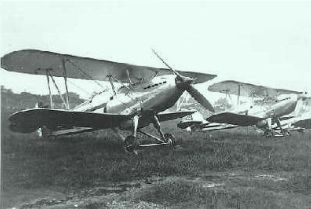
Hawker Hartebeest, as flown by Rosy
in East Africa on his first Tour.
The SAAF's first major participation in war was to provide aerial resources for the East African campaign. Rosy, by now promoted to full Lieutenant (temporary), was posted (on 17 October 1940) to 41 Squadron whose Hawker Hartebeest biplanes were engaged in strafing, bombing, artillery spotting, pamphlet dropping and photo-reconnaissance roles in the Somalia theatre. Rosy participated fully, and on 4 August 1941 was promoted to Captain and appointed Flight Commander, with a Mentioned in Despatches under his belt.
But luck is a finite quantity, and a few days after this promotion his Hartebeest was shot down while strafing a transport column. Rosy managed a controlled landing, and with the help of local tribesmen - no friends of the Italians - he and his gunner got back safely. In early November his aircraft was hit and set on fire, but by diving steeply he managed to extinguish the flames. Later in the month his aircraft was again hit, this time in the engine, but he was able to nurse it back to base.
Rosy in the Desert
With 240 operational hours to his credit, Rosy now returned to South Africa for a refresher course, before embarking on his second Tour.
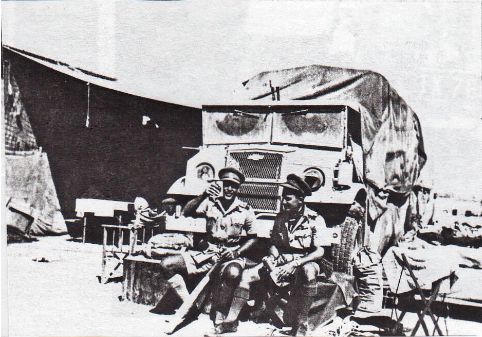
Rosy seated left - during an impromptu cricket match?
- he appears to be holding a bat (North Africa)
Initially seconded to 1 Squadron to train on the Hawker Hurricane, a low wing monoplane very different from the biplane aircraft he had flown hitherto, he was briefly transferred to 2 Sqdn, before posting to 4 Sqdn, then operating in the Western Desert with the rugged Curtiss Kittyhawks. Almost at the same time he was again Mentioned in Despatches.
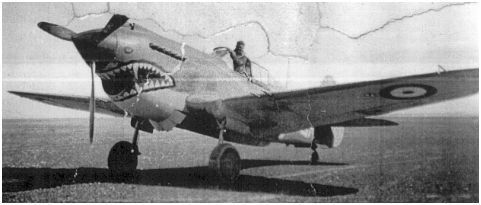
P40 Kitthawk
4 Sqdn then lost two COs in quick succession, and on 3 September 1942 Rosy was appointed to the position, with promotion to Major. Clearly he had impressed, despite his fairly brief time with the squadron. Almost every outing in those days ended in air combat with Me 109s, which clearly outclassed the Kittyhawks, whose only real advantage was a greater degree of nimbleness. The SAAF pilots took all the advantage they could from this, achieving more victories than seemed possible; nonetheless their losses were dreadful. For the next three months Rosy led his squadron on numerous sorties against enemy formations and other targets, emerging with a seemingly charmed life from many a tense encounter, often against 'unfair' odds. 4 Squadron had a 'pet' Me 109, which they had captured in late 1942. Its first flight in Allied hands (and in RAF colours) was undertaken by Rosy on 6 January. It ended in near-disaster, as Rosy managed to burst both tyres on landing!
As the North African campaign headed westwards against increasingly worn-out German opposition, various reorganisations took place at higher levels, but Rosy and 4 Sqdn continued much as before, gradually moving forward until finally occupying bases in Tunisia. Then, in mid-May, the Axis forces in North Africa surrendered, marking a definite "end" to the "beginning".
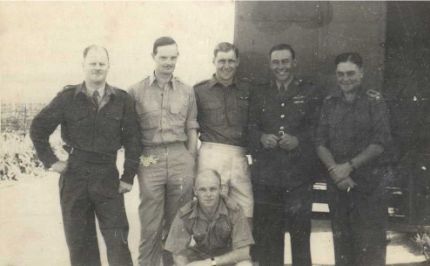
Rosy (second from right) with pilots
Rosy over Sicily and in the USA
One month later, in June, Rosy's DFC was gazetted. This must have been some consolation for the unwelcome news that 4 Sqdn (alongwith its two brother squadrons in 7 Wing, numbers 2 and 5) was going to have its worn-out Kittyhawks replaced with ... worn out Kittyhawks. Consequently, like other SAAF units similarly equipped, they were not going to be taking part in the invasion of Sicily. PM Jan Smuts was not pleased to learn that despite their superb achievements to date, his Fighter Wing was to be denied the honour of taking part in the hugely symbolic first assault on the Fascist's "Fortress Europe". Protesting to the highest level, his indignation bore fruit, and 4 Sqdn (along with No. 2) found themselves issued with Spitfire V fighter-bombers. Rosy was relieved of squadron command and instead appointed 'Sweep Leader' for the whole of 7 Wing. It is not clear whether he actually exercised this role during the conquest of Sicily, for that month (July 1943) he was sent to America at the request of the Curtiss Wright Corporation (makers of the Kittyhawk). The reason for his visit was not officially recorded, but was probably an attempt by Curtiss to obtain first-hand information on the too-frequent failure of Kittyhawk engines and bearings. (Later investigation revealed dishonest activities by engine inspection staff at the company. Heads rolled.)
Rosy in Italy
More (very welcome) Spitfires arrived in August for 2 and 4 Sqdns, and Rosy returned from the USA at the end of September to find the Allies well established in Italy. He resumed his position as Sweep Leader, carrying out missions over the Foggia landing ground. At the very beginning of October, 7 Wing moved to Gioia del Colle and was immediately pressed into service assisting RAF 244 Wing to bar the enemy from strafing and bombing the Allied advance. Days later Rosy was promoted Lt. Colonel and made Wing Leader of 7 Wing, at the same time as 2 and 4 Squadrons were to be re-equipped with fighter-bombers - 'Spitbombers' - since the need for pure fighter squadrons was tailing off with the decline in Axis aircraft numbers. Spitfires, now fitted with bomb racks, proved their worth - to some incredulity - as effective dive bombers.
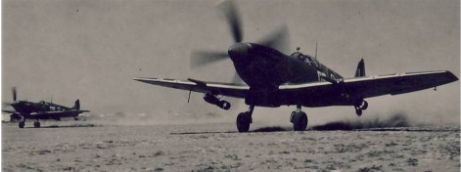
'Spitbomber' (note the 250lb bomb
under each wing) of the type flown by
Rosy over Sicily and Italy.
Later, replacing their Browning machine guns with two extra 20mm cannons (making four in all) made them fearsome ground-attack machines as well. (This fitting took place for 4 Squadron in Malta at the end of November.) Interdicting German supply lines (road and rail) became 4 Squadron's almost daily bread, their ops increasingly integrated with the Eighth Army's every move, even to the extent of taking out - with careful precision - enemy positions right in front of advancing Allied units. Other 4 Squadron operations took place in support of Tito's partisans in the Balkans.
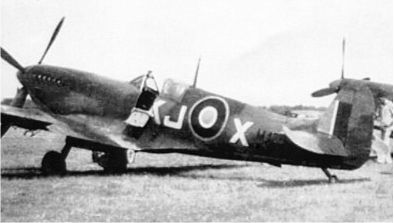
No 4 Squadron Spit
German response to Allied air activity, since they were short of aircraft, was to boost their AA defences, and on 4 November Rosy had a narrow squeak when his tail-plane was damaged by AA fire. He managed to return safely.
Just before Christmas the Wing was ordered to relocate to a makeshift airfield at Trigno, where the landing strip was of interlocking pierced steel strips, and only 30 yards(27,5m) wide. The camp and airstrip were flooded in early January, for a time making operations impossible.
January 1944 was a notable month for Rosy. In November 1943 he had led a daring and very successful low-level attack on an enemy landing ground in Yugoslavia, and in January news came through that ithad earned him a bar to his DFC. Also in that January, 7 Wing's OC went on leave, and Rosy was made Acting OC for about six weeks. This coincided with the Anzio landings, in which the Wing playing an active support role, while 4 Squadron itself continued to operate on the Eighth Army front, pursuing its interdiction missions on enemy supply lines. These included attacks on shipping off the Yugoslav coast.
Rosy becomes a Staff Officer and a Colonel
Almost as soon as Rosy relinquished his role as Acting OC, he was selected for an officers' training course at the RAF Staff School in Haifa, graduating in May with a "B" assessment. By this time, at age 25, he had 900 flying hours under his belt. The purpose of this School was to prepare middle-ranking officers for positions at the more senior levels of the air service, where it had been noted that despite the SAAF's undeniable contribution to the war in the Mediterranean theatre, their officers were sadly under-represented. Of the eight SAAF officers who passed through the school, Rosy's "B" was the highest achievement; the others receiving six "Cs" and one "D". His assessment report described him as "An extremely pleasant personality. Has shown great keenness and enthusiasm throughout the Course ... [he] should make a sound and reliable staff officer"..
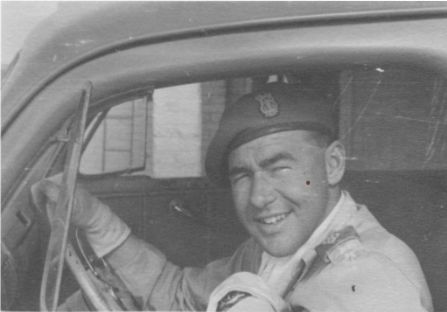
Colonel S F du Toit
Rosy gets his own Wing
And indeed, before long Rosy was transferred from the SAAF to Staff Corps (V), promoted to Colonel (still only 25!), and charged with creating his new command: No. 8 Fighter Wing (which would be one of only three South African Wings operating in the Mediterranean theatre). For this he was assigned a mix of two RAF and two SAAF squadrons, plus an RAF Repair and Salvage Unit. The SAAF squadrons flew Kittybombers (11 Squadron), and Spitfire IXs, or 'Spitbombers' (3 Squadron).
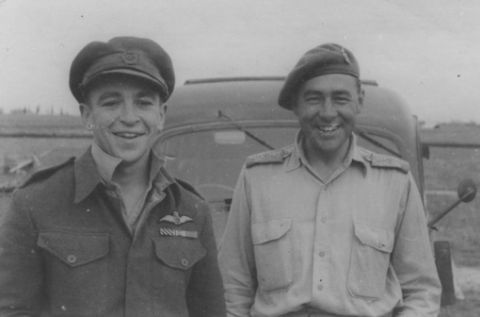
Colonel S F du Toit Rosy (right)
with Major Cecil Golding,
a squadron commander in Rosy's 8 Wing
Rosy's 8 Wing HQ moved to Borghetto on 10th September, was joined by the RAF squadrons on the 16th, and commenced operations the next day. Then poor weather made the landing ground difficult to use for six days, and only about six sorties were possible. A week later 3 Squadron arrived, fresh from dive-bomber training; 11 Squadron was still awaited. At about the end of the month, the Wing moved to Fano Airfield, another steel-plate landing strip with minimal facilities - and, as the Italian winter set in, a surfeit of mud. The weather became briefly kinder by mid-October and regular operations resumed. These included pamphlet drops to encourage German surrender, under the mistaken belief that the enemy was at breaking point. They weren't, and the fighting stayed tough. The weather also continued tough, and heavy rain repeatedly flooded the field, preventing operations. This, along with repair work to the landing strip and facilities, allowed the Wing only six flying days during the whole month.
Then came orders to move the Wing to Florence in early November to provide support for the American Fifth Army. Rosy was additionally to be airfield commander. He reconnoitred his new assignment ahead of the transfer and was appalled: the airfield had a single concrete landing strip, but for the rest was a sea of mud where it was not actually flooded. While heavier machines could more or less plough through, his lighter fighter-bomber aircraft would barely cope. Nor were there any hard standings for his machines. Nonetheless, the move had been ordered and the Wing's ground personnel - joined at last by those of 11 Sqdn, hitherto operating from Perugia - arrived at its new billets on the nightof 12/13 November. They were a half-mile mud walk from the officers' mess, and six miles from the airfield!
The Wing's aircraft flew in on 17 November, less those of 11 Squadron, who remained 125 miles away at Perugia due to lack of space at Florence. Operations in support of Fifth Army's operations in the Bologna region continued, increasingly interrupted from time to time by snowfall. While the war continued, along with the German retreat and their continued fierce resistance, a move to an airfield at Pontedera (between Florence and Pisa) was proposed for the Wing. However, Rosy dismissed it as unusable until hard-standings were created. This was done and the Wing moved there after Christmas, once the upgrades were completed as Rosy required. In other respects the airfield, already in use by the USAF, was a great improvement, with the warmth and comfort of permanent quarters greatly appreciated after the rain, snow and cold of the tents at Florence. Here, also, there was room for 11 Sqdn, and the Wing was all together for the first time since its formation.
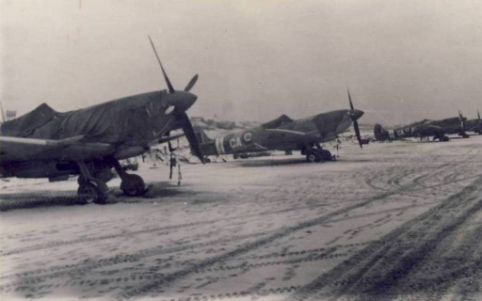
Italy 1944: 'Spitbombers' of
Rosy's Wing wrapped up against the
freezing conditions
Rosy in on the 'kill'
Two new kinds of mission became more frequent now, in addition to the familiar tasks of cutting German supply routes. One was flying close support to Dakotas dropping supplies to Italian partisans operating behind the German lines. The other was participating in "cab rank" missions: standing patrols of fighter-bombers lurking above the front which could be quickly called down as needed to take out enemy positions holding up the ground troops. The Wing also undertook a number of missions against particularly important targets - oil dumps, German HQs, and the like - in which all four squadrons participated together.
The final great air offensive of the Italian campaign began on 9 April 1945: 1,700 Allied aircraft took part, with 8 Wing in the spearhead. German resistance weakened under never-ending aerial and ground attacks: they retreated, then grew desperate, then crumbled, and finally, in defiance of Hitler's delusional orders, surrendered on April 24. Rosy's Wing participated at every stage of this triumphal ending to months of slogging combat against a stubborn enemy and unhelpful climate. Indeed, on the day before the surrender the Wing's Spitfires and Kittyhawks flew an astonishing 190 sorties, despite having only 57 serviceable aircraft left, and despite the weather.
The war in Europe trickled on for a few more days, until the final capitulation in the early hours of 2 May 1945.
Rosy in the aftermath
The end of the war brought relaxation (and reflection) but no immediate end to duties. Rosy's wing took part in a Victory Fly-Past of 500 aircraft above the Campoformido airfield. The Desert Air Force (DAF) was represented by 43 squadrons, 13 of them SAAF. And besides victory, it also signalled the separation of the SAAF from the DAF, after so many months of shared endeavour and sacrifice.
On 30 October, 8 Wing journeyed back to Egypt, there to be disbanded. On the first day of the New Year (1946) Rosy, grandson of an 1899 Boer Kommandant, was made a CBE (Commander of the most Excellent Order of the British Empire). In February he was seconded to the Demobilisation Directorate, and appointed as the Officer-in-Charge of the London Demobilisations office, arriving there on 6th March. The assignment ended in December.
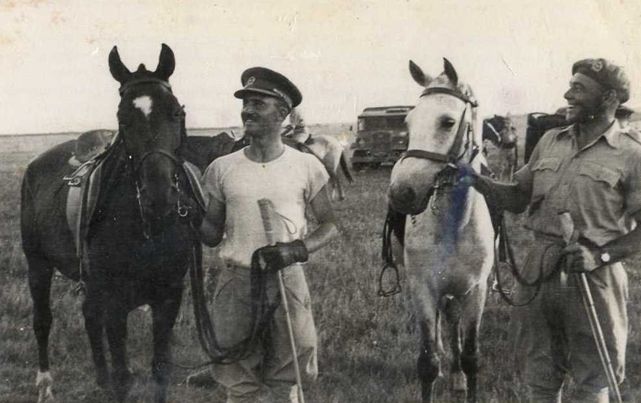
Jack Parsonson and Rosy enjoying
some downtime after German surrender
- riding on an airfield in Italy. Rosy
was a keen and accomplished horseman.
Rosy in love
Sharing the Pontedera field with the USAF in 1945 had brought a benefit to the Wing's aircrew they had not enjoyed before. Once landed back from their missions, three American Red Cross nurses were always on hand, ready to serve them with hot coffee and doughnuts! Rosy benefitted mightily from this arrangement, for he and one of the nurses, Jinx Cole, fell in love. Soon after the war, on 1 June 1946, during his sojourn in London, they were married in Kensington.
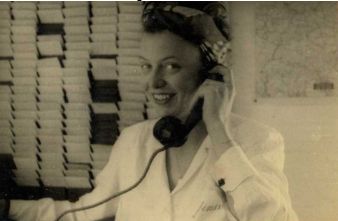
Jinx Cole - the USAF nurse who
became Rosy's first wife in 1946
A slightly belated 'wedding gift' came from the US authorities later that month in the form of the award of the American DFC, reflecting 8 Wing's work on Fifth Army's front.
Rosy in peace time
On 19 December Rosy and Jinx (surely one of the most curiously named couples!) sailed for South Africa. Soon after arrival, Rosy was attached to GHQ, Pretoria. A year later he embarked on a stint as a Military Attaché in Washington. During this time he attended several USAAF-run training courses for various ranks, (including undergoing paratrooper training at Fort Benning), apparently to assess and report on their suitability for South African personnel. This period ended with a six-month secondment to the USAF, this time to study their methods of aircrew training, and employment of fighter aircraft.
Rosy returned to South Africa in early January 1949 and was posted to 2 Sqdn at Waterkloof Air Station as Station Commander.
South Africa's political world had turned upside-down in 1948 when DF Malan's Nationalist Party ousted Smuts' United Party. Purges and career-blocking immediately began of those known or suspected of having 'British' sympathies, and/or loyalty to the Smuts government. (The parallels with today's USA are ... interesting?)
Rosy had little sympathy for the new dispensation, and few illusions about his own future under it.
His letter of resignation is dated 12 June 1950 and came into force four days later. His offer to transfer to the SAAF Special Reserve was, however, accepted. Around that time Rosy's forwarding address was a sugar estate near Chakaskraal, some 30 miles (50 km) north of Durban; by 1954 it was a sugar estate at Luabo, in what was then Portuguese East Africa, now Mozambique, and later still, Fort Victoria in Southern Rhodesia (Zimbabwe). At all these stations Rosy held managerial posts of increasing seniority, culminating in appointment as general manager of the Chirundu Sugar Estate in the Zambezi valley, northern Southern Rhodesia.
By 1962, Jinx's health was deteriorating, and Rosy moved to the Salisbury area, where the climate was less wearing, and took up cattle farming, successfully. Sadly, their time together there was relatively brief, for Jinx died in 1964 after 18 years of marriage.
Rosy remarried four years later (1968), but in 1973 the political situation in the then Rhodesia persuaded him that he (at 59) and second wife Norma had to get out, come what may. They emigrated, virtually penniless, to New Mexico in the USA where his lifelong enjoyment of, and skill at, horse riding got him a job as a cowboy, riding the range!
But Rosy was Rosy, and within fourteen months he was manager of an entire ranch. Life with Norma did not work out, however, and they divorced. At one point in New Mexico, Rosy became seriously ill with a malady the hospital could not diagnose. Rosy suggested they check for malaria - and there it was, a legacy from his time at Chirundu.
Rosy returns
In 1983 Rosy returned to South Africa and retirement in Cape Town, where he embarked on a third, and happy, marriage to Lt.-Gen. George Brink's daughter Doreen. He died, without issue, in 2009 at the age of 90. A leader of men, a fearless air- warrior, a conqueror of misfortunes, deserving of 'South African hero' status.
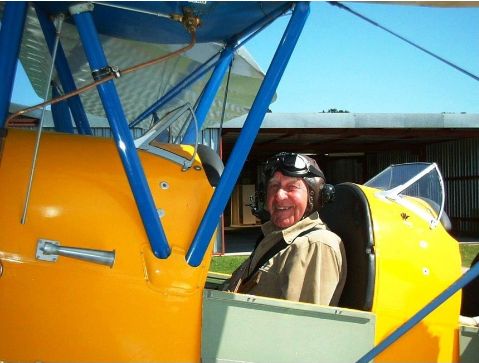
Rosy aged 86 about to fly a friend's
Tiger Moth at Stellenbosch in 2005
About the Author
Stef’s family, on both sides with strong Afrikaner roots, responded to General Smut’s call to arms and served in WW II. Two maternal (du Toit) uncles served in the SAAF, an aunt as a WAAF. His father, injured serving in North Africa, returned to join Dr. Ernie Malherbe’s Information Corps to counter Nazi seditionists within South Africa. His father’s youngest brother, Jean Coetzee, lost his life in January 1945 and is buried at Castiglione Dei Pepoli.
In this 80th anniversary year of VE Day, resulting in so much coverage of central Europe, the contribution of South Africans in East and North Africa and Italy is somewhat overshadowed. This motivated Stef’s efforts to help him piece together his Oom Fanie’s (aka Rosy du Toit’s) experiences.
Return to Journal Index OR Society's Home page
South African Military History Society / scribe@samilitaryhistory.org