
 The South African
Introduction
The writer was a curator at the Ditsong National Museum of Military History from 1983 until 2022. One of the many collections curated was the accoutrements department which has a large collection of helmets from the first and second world wars. Most numerous helmets in the collection were the British type. Of these, most had the Union Defence Force's (UDF) distinctive three holes in the rear rim, as worn during the Second World War (1939-1945). This article is an attempt to write a fairly comprehensive account of the production of the South African manufactured steel helmet.
Background
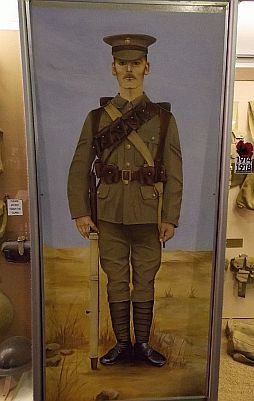
The British and British Dominions armies started the First World War (1914-1918) wearing a variety of soft headgear. The most common headgear in Europe were the Pattern 1905 Service Dress Cap and later the winter version which was nicknamed 'Gor blimey'. These were followed by the 'Soft Cap'.. The Scottish regiments wore a Glengarry, Tam-o-Shanter or Balmoral. Most of the Union Defence Forces fighting in German South West Africa, German East Africa, Egypt and Palestine wore the Wolseley Pattern sun helmet, introduced into British service in 1903.
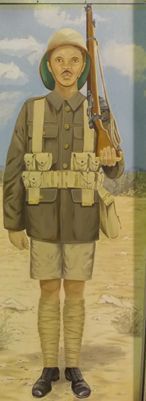
Wolseley Pattern helmet
1905 Service Dress - Cap
The Brodie Pattern steel helmet
During the First World War, the French were the first to produce a steel helmet to reduce the number of head wounds from shrapnel and high explosive shells. The Model 1915 Adrian helmet was introduced into French service in July 1915. The British War Office evaluated the Adrian helmet and found it did not offer sufficient head protection and its production process was overly complex.
John Leopold Brodie, born in 1873, was a self-styled engineer working at the Army and Navy Stores in London. He used the British medieval chapel de fer infantry helmet as the basis for his design. Made from mild steel, and pressed in a single pressing, it had a shallow circular crown with a wide rim and a raw edge. The liner, to enable the helmet to sit on the head, had a simple padded crown with an oil cloth liner riveted to the centre of the bowl. He submitted his design in August 1915. The British War Office approved his design. In a few weeks they had pressed about 4 400 of this type, to be issued, in September 1915, on a rotational basis - 50 helmets to each battalion - to the troops in the very front lines. It was known as the 'Brodie Steel Helmet, War Office Pattern'. This very first type was later renamed Type A. Both types were made from mild steel. Sir Robert Abbot Hadfield proposed that the British War Office use the steel he had developed in the production of the Brodie helmet.
Hadfield Steel
Robert Hadfield was born on 28 November 1858 in Sheffield, England. He worked in his father's foundry. He had a great interest in metallurgy and had studied alloy steels, especially the addition of manganese to mild steel.
He was specifically looking for a steel alloy for casting tram wheels which would be both hard and tough. In 1882 he found that the addition of 13.67% manganese and 1.35% carbon produced an unexpected dull metal which sheared the teeth off his file and could not be cut with a saw or machined on a lathe. Grinding simply polished the surface and although it consisted of 80% iron it was non-magnetic. He patented his steel in 1883. In 1908 he was knighted as Sir Robert Hadfield for his work with alloy steels.
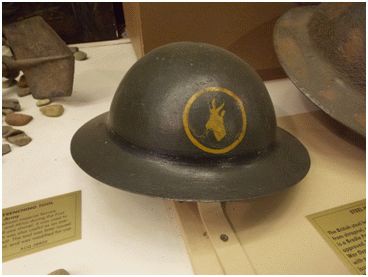
Original Brodie helmet with
1st South African Brigade emblem.
Note the raw rim edge.
The pressing of the Brodie Helmet using Hadfield steel started in October 1915. The new helmet known as the Brodie Type B was made from 20 gauge / 0.995 mm thick steel and had a manganese content of 12%. The helmet was about 12 inches (305mm) long and 11 ¼ inches (286 mm) wide. It had a mass of 2,4 lbs (1.088kg). The type B helmet gave a much higher impact strength than the original Brodie and was more resistant to shrapnel, stones and other debris thrown up by bombardments. The helmet's official name at this time was Helmet, Steel Mark 1. In a short time, 250 000 had been pressed and these were ready to be used in the battle of St Eloi in April 1916. By the summer of 1916, the first million helmets had been produced and issued to British and British Dominion troops on the Western Front.
The 1st South African Infantry Brigade (Western Front 1916-1919) and their use of the Helmet, Steel, Mk 1
The 1st, 2nd and 3rd Regiments of the brigade wore the 1905 Pattern Service Dress Cap, while the 4th (SA Scottish) wore Balmorals or Tam-o-Shanters. In December 1915 they prepared to fight in Egypt against the Senussi and were issued with Wolseley pattern sun helmet. In mid April 1916, they left Alexandria and five days later landed at Marseilles, France for service on the Western Front. The brigade received their Helmets, Steel, Mark 1 in June/July 1916 from British stores and formed part of the 9th Scottish Division. Helmets were at first often painted with the regimental symbol and later in camouflage paint to disguise the shape and glint from the helmet. Hessian and khaki cloth was also used to cover the helmets. Officers were expected to purchase their own helmets. These helmets were worn during the Somme offensive and later battles up to the end of the war. When the Armistice came into effect on 11 November 1918, the 1st SA Brigade had lost 5 000 men dead and another 10 000 wounded.
Before returning to the Union of South Africa, British equipment issued to the Brigade had to be returned to British stores. All of the Helmets, Steel, Mark 1 in the accoutrements collection of the Ditsong National Museum of Military History are therefore officer's helmets which were privately purchased and so could be brought back to the Union after the war.
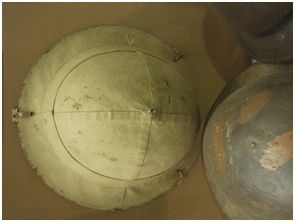
To protect against helmet glint,
some helmets were covered in cloth.
Between the wars
The post-First World War UDF reverted to wearing the Wolseley Pattern sun helmet. In about 1935 a new Polo Pattern helmet came into general service with the Union Defence Forces. When the Second World (1939-1945) started, this was the helmet which was in general use and was worn by all men of the 1st South African Infantry Division in East Africa. Both the 1st and 2nd South African Infantry divisions used Polo helmets during the early stages of the North African Campaign often with an attached neck veil.
The distinctive three holes in the rim of the South African manufactured helmets was to fit a neck veil.
Up until about 1941 it was erroneously thought by medical personnelthat exposure of the head and neck to rays of the sun, especially in the tropics, was highly dangerous. South African troops were thus ordered to wear their Polo helmets even when attending church services in the East Africa theatre. Many soldiers added a neck veil attached to the rear of the Polo helmet to cover the neck and spine and protect against heat stoke. In the early stages of the North African Campaign it was found that men digging trenches in the midday sun without any headgear but drinking sufficient water did not necessarily suffer from heat stroke. By this time, however, the punching of the distinctive three holes in the South African helmet had been included in the production process and continued to be used even though it was now not needed.
So when and how did South African start producing steel helmets for the Union Defence Forces?
The Union War Supplies Board
In 1937-38, the South African Government appointed a small board of military and civilian personnel to the Union War Supplies Board. Their task was to investigate, aided by practical experiment, the resources of the Union of South Africa available for the production of warlike stores and materials in case of emergency in South Africa. In September 1939 a list of technical stores and their numbers, in order of priority, was compiled. Twelfth and bottom of the list was a preliminary requirement for 60 000 steel helmets. This number would be sufficient to supply the then Permanent Force and Active Citizen Force. This small programme was later merged with a huge programme undertaken by the Director-General of War Supplies as the war progressed.
The Transvaal Steel Pressing Syndicate
Oluf Larsen was born on 25 January 1886 in Copenhagen, Denmark. He married Bertha Christiansen in 1909 and they came to South Africa in 1911 to join the dairy industry. He soon found that the Union did not use a standard metal milk can. In 1924, he founded the Transvaal Steel Pressing Syndicate (TSP) specialising in the manufacture of sanitary pails. In 1932 he branched out to the manufacture of tinned steel five, eight and ten-gallon milk cans. These cans, picked up by passing trains at farm junctions, became very well-known with their TSP mark on the bottom. He was a big and forceful businessman and came to hear of the original War Supplies Board's need for 60 000 helmets and that no other company in South Africa had the ability to press helmets. He had apparently not arranged a contract with the Director-General War Supplies before he set out to obtain the equipment he needed, not sure if it was available or not. He acted quickly and visited Great Britain in September/ October 1939 with the aim of purchasing the required presses and steel.
In 1938 Britain had started to manufacture their new Helmets, Steel, Mark 2. It is believed that Larsen purchased some of the redundant presses for the older Helmets, Steel, Mark 1. These were no longer needed and Larsen could get them at a good price.
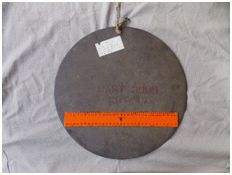
A blank manganese steel plate
for forming into a helmet, also part
of the Museum collection.
He also purchased sixty thousand blank manganese steel disks to press into helmets. He arranged for his purchase to be to shipped to South Africa. Since these helmets were pressed using Mk 1 presses and a new liner was supplied in South Africa, the correct nomenclature for this helmet should be Helmet, Steel, Mark I* and not Mark 2 as is commonly thought. While he waited for his shipment to arrive, he had to convince his Board that the business deal he had just concluded was economically sound. He then signed a contract with the Union's Director-General War Supplies to press the helmets at a cost of 17 shillings and two pence per helmet. The presses and blank plates arrived at the end of the year and were set up at the TSP factory in the industrial areaof Selby, just south of the city centre of Johannesburg. The 60 000 helmets were pressed by May 1940 at a rate of about 6 000 a week. These helmets were without the distinctive 3 holes in the rear rim.
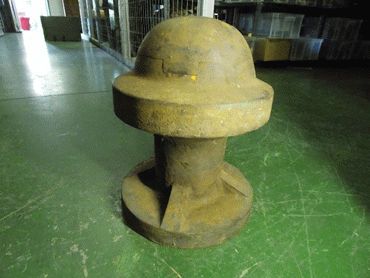
One of the male presses for Helmets,
Steel, Mark 1, purchased by Oluf Larsen.
Today it is part of the collection at the
Ditsong National Museum of Military
History in Johannesburg.
The painting and fitting of helmet liners and chin straps: Painting Company
Herbert Evans & Company Ltd was formed in 1889 when the Welshman, Herbert Evans, arrived in Johannesburg. In 1910 he launched the first ready-mixed colour paints in South Africa. In 1915 his trademarked Parthenon Paints became a household name. This was the brand that he supplied to the Union Defence Forces throughout the Second World War. The UDF standardized on a set of sixteen different paint colours for all uses which could then be easily ordered by quoting the colour chip number.
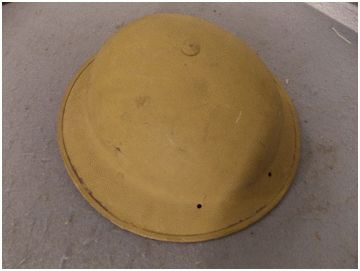
The standard paint colour used in 1940 was a light to medium green. The green colour paint used on the first South African armoured cars, is seen on one of the original helmets shown on the inside back cover of this issue. This paint colour was found and matched during the restoration of the South African Armoured Reconnaissance Car Mk 1 (Ford) carried out at the Ditsong National Museum of Military History in 1990. An unfinished helmet in the same colour was also discovered in the Museum store, suggesting a more widespread use. It is not known if all of the original 60 000 pressed helmets were painted in this colour though it seems probable. After spray-painting, the helmets were sent to Jager Rand Ltd for the fitting of the liners.
The Jager Rand Liner
Leslie Harmens Jager was the chairman and managing director of Jager Rand (Pty) Ltd. He was born on 26 July 1900 and educated at St Johns College and Michaelhouse, Natal. As a young man he served as a pilot in the Royal Flying Corps in 1917. Here he gained some knowledge of Helmets, Steel, Mk 1. In 1940 Jager Rand were making a variety of small electrical appliances but these were not required by the UDF. Wanting to assist the war effort and grow their business, they were contracted to manufacture helmet liners. Based on the more than 60 helmets in the Ditsong Museum collection, all liners were either manufactured in 1940 or 1942. Why the Museum has no liners made in 1941 will be discussed below.
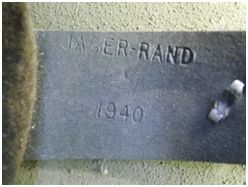
Jager Rand marking
and 1940 date stamp
The chin-straps
D.I. Fram was a Jewish immigrant from Eastern Europe who set up a canvas and webbing related business in Johannesburg. During and after the Second World, they too had a factory in the Selby area of Johannesburg and made most of the South African manufactured Pattern 1937 webbing, large packs, pouches, straps, and other related canvas and web equipment. It is believed that they made the chin straps on the steel helmets.
What happened to the first 60 000 helmets?
Men of the 1st South African Infantry Division were training in Eastern Transvaal and by end of April 1940 were ready for deployment. They were issued with the Polo helmet introduced into UDF service in 1935, as the steel helmets were not yet available. The first South African soldiers to be issued with the new TSP-pressed helmets were the crews of the quick firing antiaircraft gun Mk III. These men of the 1st South African Anti-Aircraft Regiment were the first shipped to Kenya to defend Mombasa port against possible air attack in May 1940. Also thought to have been issued from the first batch of helmets were the Cape Coloured gunners on Robben Island. Some were used as samples and for promoting the achievement of South African industry at the start of the war.
Production of the initial batch of sixty thousand steel helmets was completed by mid May 1940. In September 1940 the 'Blitz' bombing of British cities started. There was an urgent requirement for helmets for civilian fire fighters, non-combatant civil defence service-men and women involved in assisting the public of British cities during the 'Blitz'. Most of the South African-produced steel helmets were therefore shipped to Great Britain for this purpose.
The difficulties in obtaining steel plate to press more helmets
January to May 1940 was a feverish time for producing arms and equipment for the UDF as the normal importation from Britain was by then severely restricted. Britain required all the arms and military equipment made in Great Britain and Canada for her own armed forces and could not spare any for South Africa. The helmet presses were ready for working and Jager Rand had manufactured many more liners but the manganese steel plate was unavailable in South Africa. The only company able to produce this steel plate in South Africa was the Iron and Steel Corporation (ISCOR).
ISCOR were working at a frantic pace, 24 hours a day and enlarging blast furnaces in Pretoria to produce the steel of the type that the Director- General War Supplies required for arms for the Union Defence Forces. Their priority was to produce armour plate for the South African armoured cars and to supply steel of the correct type to foundries for the manufacture of bombs, shells, hand grenades and ordnance. The development of the lower priority thin manganese steel plate for steel helmet production would have to wait.
ISCOR
On 5 June 1928 ISCOR was formed under the Chairmanship of Dr Hendrik Johannes van der Bijl, with the backing of the government and using German engineers. The first steel from the factory was tapped on 4 April 1934. Steel mills able to produce 30 000 tons of sheets were completed in 1934. However, by 1939, with war clouds looming in Europe, the German engineers left, either voluntarily or interned after the declaration of war. ISCOR was left with working furnaces but without the expertise to produce the steel required for the war effort.
By trial and error and using very primitive modifications to the existing plant, ISCOR was eventually able to produce enough steel for the railways and harbours and the mining industry. For the Union Defence Forces, armour plate for the armoured cars, steel ingots for artillery barrel production and, nearly a year later, the manganese steel sheets of 20 gauge for steel helmets were produced. A First World War helmet was examined at ISCOR and eventually they produced a steel plate which passed the Erichsen cupping test to determine the deformation behaviour of the plate. The delay was not for the lack of manganese, South Africa, in 1939, having produced 463 000 tons of manganese ore, but rather the lack of technical know-how. ISCOR began to produce quality manganese steel plates from March 1941.
Production continues
With the arrival of the manganese steel plate from ISCOR, the production of South African-produced steel helmets entered a new phase. TSP were able to press up to 8 000 helmets per week. The process at TSP was as follows:
Using male and female presses, a 370 mm diameter manganese steel disc was placed above the female mould/press. A hydraulic press was released by the technician and the male press forced the disc plate into the female mould. The outer rim of the pressed helmet now often had corrugated ridges. The pressed helmet was stacked and then moved to the next station where the corrugated edges were trimmed. A hole was punched in the centre of the dome of the helmet and the distinctive three holes for the long-discarded neck veil in the back rim. The last process at TSP was the fitting of a supposedly anti-magnetic channel around the sharp rim. The channel was spot welded on the left of the wearer at 9 o'clock position. Remember that the whole helmet made from manganese steel and was anti-magnetic. A staff member from DGWS inspected and approved the quality of each batch ofhelmets.
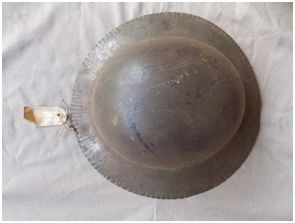
Note the corrugations on
the newly pressed helmet
ISCOR supplied enough manganese steel plate for 250 000 helmets. From early 1942 the United States steel industries supplied the required manganese steel plate to South Africa for pressing.
The helmets were then moved less than two kilometres to Herbert Evans for spray painting. In March/ April 1941 they were painted in a medium to dark green colour for issue to men of the 2nd South African Infantry Division under-going training in the Carolina area of the eastern Transvaal. After painting, they were sent back to the Selby area for the fitting of the liners. Once it was known that the 2nd Division was destined for Egypt, the helmets were painted in a sand colour. The 1st South African Infantry Division were about to move from East Africa to Egypt and were still wearing their Polo helmets. This division would also later be issued with sand coloured helmets, some with liners dated 1940 and others with liners dated 1942.
From May 1940 until the end of the year, while TSP were waiting for ISCOR to manufacture manganese steel plate, Jager Rand continued manufacturing thousands of liners in preparation for these helmets. Although the second batch of helmets was only pressed from March 1941, all the liners were made and dated 1940. Of the 60 helmets in the collection of the Museum, fourteen are stamped 1940 and most of the rest dated 1942. A few have no visible date stamp but none have a 1941 date stamp.
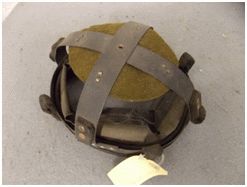
Liner made by Jager Rand
The fitting of the completed liner was simple: a 15 mm diameter brass screw was placed though a hole in the dome of the liner and helmet and fastened with a flat dome nut on the exterior of the dome. Excessive visible screw threads were ground off flush with the nut. It is thought that Jager Rand also fitted the chin straps supplied by DI Fram.
A pre-determined sample was taken from each batch for bullet proof testing. Although only 0.944mm thick, the steel was able to resist the penetration of a 200 grain pistol bullet with a muzzle velocity of 190 m/s. This was because the manganese steel plate had a high formability - it was able to undergo plastic deformation without being damaged.
Once the batch was bullet proofed they were handed over to the Quarter Master General (QMG). The quartermaster unit of the 2nd SA Infantry Division would then collect the helmets from QMG for issue to the units of the 2nd Division. Each unit quarter master staff would exchange the soldier's Polo helmet for a new steel helmet against signature on a UDF issue voucher. The first men of the 2nd Division arrived in Egypt from 21 June 1941. The same procedure applied for issue to the men of 1st Division and later the 6th South African Armoured Division. Reserves for either the 1st, 2nd or 6th armoured division were issued with helmets of the appropriate colour in the Union of South Africa. Other soldiers who were to remain in the Union also received their steel helmets.
The Eastern Group Supply Council (EGSC)
The EGSC was formed at a conference of the governments of India, Australia, New Zealand, South Africa, Southern Rhodesia, Kenya, Uganda, Tanganyika, Northern Rhodesia, Nyasaland, Zanzibar, Burma, Ceylon, Hong Kong, Malaya and Palestine, held in Delhi, India, from 25 October to 25 November 1940. It was agreed at the conference that the above counties would adopt a Joint War Supply policy. The maximum use would be made of the existing and potential capacity for war supply for each country. Items supplied by South Africa included boots, blankets, canvas shoes, anti-gas eye shields, vaccines, serums, portable cookers, and helmets, and after the UDF had been supplied with the new batch of helmets, continued production went to the EGSC. On 9 April 1945 TSP pressed their 1½ millionth helmet. This was presented to Dr Hendrik van der Bijl, the Director-General of War Supplies.
Cost of the helmets
The cost of 17 shillings 2 pence per helmet to the DGWS for the first batch produced in South Africa covered the cost of importation of machinery and supplies and the cost of setting up the production. By the end of the war, with 1½ million helmets produced, the unit cost had fallen to 7 shillings 6 pence.
Helmet colours
In general, the first helmets produced were painted in the light green as supplied for the first 113 South African Armoured Reconnaissance Cars Mk I (Ford). After ISCOR started to supply the steel plate to TSP, the colour changed to a medium to dark olive green. Once the 1st and 2nd divisions were in North Africa the normal helmet colour was a sand colour, some more sand brown than others. For the Italian Campaign, some wore the sand colour helmets and others, dark green. New recruits wore a brown coloured helmet. In the Italian winter of 1944 in the snow covered Apennines, some men sensibly covered their dark helmets with a white cloth. In 1954, the South Africa Army approved a new colour, Light Stone, for much of its new equipment. Some helmets used by the UDF at this time were painted in Light Stone. In 1962 a new colour, Olive Drab Semi-Gloss, was approved for general use.
The following colour photographs were on the inside back cover of this issue:
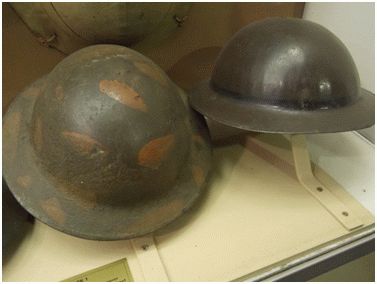
Helmets used by SA soldiers in WWI
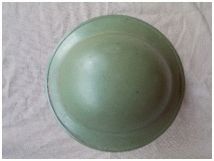
This helmet was painted
in the same green colour as
the SA armoured cars in WWII
Sand coloured helmet with three holes
punched for a sun veil which was
discontinued after sunstroke was
found to be less of a problem
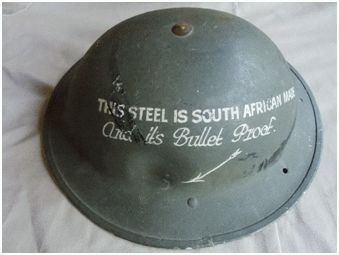
Advertising that the later version of
SA made steel helmets was bullet-proof
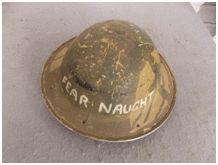
Customising of
an officer's helmet
A new helmet
In the 1950s, South Africa continued to use British and American equipment. After South Africa became a republic in 1961, there was a political need to break from British colonial domination, and other sources were sought for military supplies. In 1963, the new South African Defence Force obtained permission from France to reproduce her French Modèle 1951 helmet. Thus Fuchs produced this model South African 'Staaldak' helmet until 1983. It was painted in the 1962 colour Olive Drab Semi-Gloss. The first recipients of the new Model 1963 helmet were Permanent Force personnel followed by balloteers who were undergoing initial training at one of four training units. When National Service was introduced in 1967, the Model 1963 helmet was issued to all new soldiers. The Citizen Force also started to receive these helmets at this time, but Commando units would have to wait until 1970 for their Steel Helmet Mk I* to be replaced by the Model 1963helmet.
The Model 1963 helmet was replaced in 1983 by a Kevlar helmet based on the Israeli OR-201 helmet.
Conclusion
Using source material from the collections at the Ditsong National Museum of Military History has enabled the filling in of some of the unknown aspects in the production of steel helmets in South Africa. I hope the article above in turn assists further research into this little known topic.
References:
This article is based, primarily, on the tangible evidence provided by the 66 Helmets Steel Mark 1 and Helmets Steel Mark 1*/2 in the accoutrements collection of Ditsong National Museum of Military History in Johannesburg, South Africa.
Publications:
Chambers, SJ Uniforms & Equipment of the British Army in World War 1 Schiffer Publications, Atglen, USA
Chappel, M The British Soldier in the 20th Century - Field Service Head Dress 1902 to the present day Wessex Military Publishing, Hatherleigh, 1987
British War Office Medical History of the Second World War - pages 82/83
Digby, PKA Pyramids and Poppies The 1st SA Infantry Brigade in Libya, France and Flanders 1915-1919 Ashanti Publishing, Rivonia, Johannesburg 1993.
Donaldson K (ed) South African Who's Who 1953 Ken Donaldson, Johannesburg, 1953
Thomson, AG The Years of Crisis The South African Federation of Engineering and Metallurgical Associations, Johannesburg 1946
Union of South Africa The Official Year Book of the Union of South Africa 1933-1934 No 16 Government Printer, Pretoria, 1934
Union of South Africa The official Year Book of the Union of South Africa 1940 No 21 Government Printer, Pretoria 1940
Union Defence Forces A record of the Organisation of the Director . General War Supplies (1939-1943 and Director-General of Supplies (1943-1945) LB Grey & Co, Johannesburg, 1946
Williamson,H The Collector and Researchers Guide to The Great War Vol II, Small Arms Munitions, Militaria Privately Published Anne Williamson, Harwick, Essex, England, 2003
Shadrake D WW1: Combat helmet technology - the Brodie steel helmet published in E&T Magazine 16 June 2014. Retrieved 2 March 2022
Internet:
Website: About Herbert Evans / History
Retrieved 2 Feb 2022
Telephonic Conversations with previous
senior manager Mr Mike Parsons
and
previous owner of Herbert Evans Paints
Mr Len Burger
Wikipedia - Mangalloy - Retrieved 2 March 2022
Wikipedia - Robert Hadfield - Retrieved 2 March 2022
About the Author
This is the third article from Richard Henry to be published in the Military History Journal.
Richard comes from a military background with a great great uncle winning the VC in Crimea and his brother and sister both serving in the Permanent Force in the 1980s.
His military service was with 2 SAI from 1979, Regiment President Kruger from 1981 -1985 then with 1Bn Transvaal Scottish until 1996 attaining the rank of Staff Sergeant.
Return to Journal Index OR Society's Home page
South African Military History Society / scribe@samilitaryhistory.org