
 The South African
My father, Gideon Francois Fourie, called Frans, was ten years old in 1899 when the Anglo-Boer War began. His father had been born at Fraserburg when his family trekked out of the Cape in 1837.
The Fouries of that family were rather silent people, irritatingly so, because one never heard them recounting events of the past as my mother's family did. Thus it was that I only learnt about the War when I reached standard Five in 1944. Occasionally, in contrast, my mother talked about the past. Her family were living in Johannesburg, when it was occupied by British forces. She had some tales to tell but soon after the British arrived in Johannesburg her German father, worried about his daughters' safety, sent his wife and children to live with his parents in Germany.
Mom spoke of watching with other Johannesburgers, from the top of a mine dump, the battle outside Johannesburg, no-one realising that the bursting artillery shells might injure them. She remembered seeing horse-drawn ambulances passing their home near Crown Mines, some days later and of hearing the groans and cries of the wounded behind the ambulance's white canopies. I remember her tales of hearing nearby bugle calls when the train to the coast stopped for the night to avoid running over lines sabotaged by Boer commandos. But neither she nor my father ever explained the War to me.
My father never spoke of the Anglo-Boer War. Only in 1944 did our teacher, recently returned home from the Second World War Western Desert campaign, spend a morning talking about the Anglo-Boer War - the concentration camps, the burning of farms and towns and the slaughtering of animals. It was quite different from my mother’s memories.
The evening after hearing about the War at school, I began questioning my father. Finally I asked, "Did the English do anything to you?" My father said "Yes, my son, they made me lose my cat." "How did they do that?" I asked and then he told me.
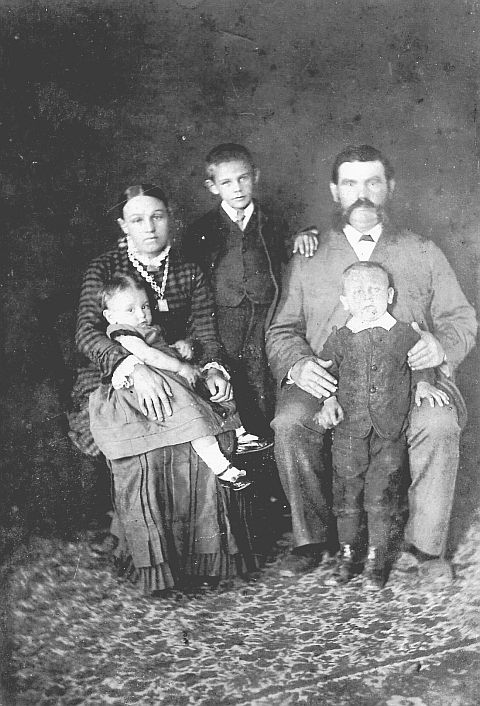
Frans's father was farming near Boshoff, in the Free State, when the British arrived there. A British regiment, apparently Highlanders, camped on the farm in early 1900.
My father used to walk to the camp and stare at their activities, as little boys will. He even developed a liking for bagpipe music, just from hanging about the camp.
For a while all went well, the friendly soldiers taught little Frans to play cricket and soccer.
Far from being defeated, by October the Boers were attacking the British garrisons left at Jacobsdal, Jagersfontein, Philippolis, Fauresmith, Bothaville, Boshof and Kalkfontein.
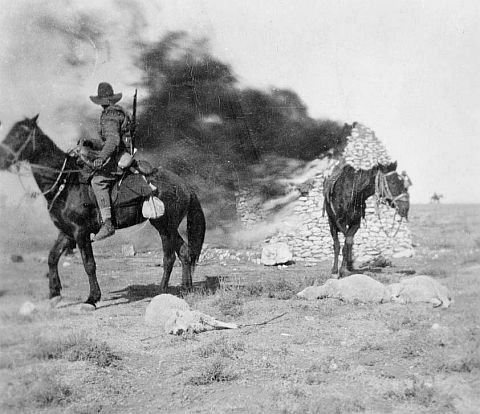
Field Marshal Lord Roberts, who had reported the war over, was annoyed. He ordered the burning of farmhouses and the destruction of livestock and farmlands, wherever the Boers continued military operations against the occupying forces - a method he had learnt to use in the North-West province of India.
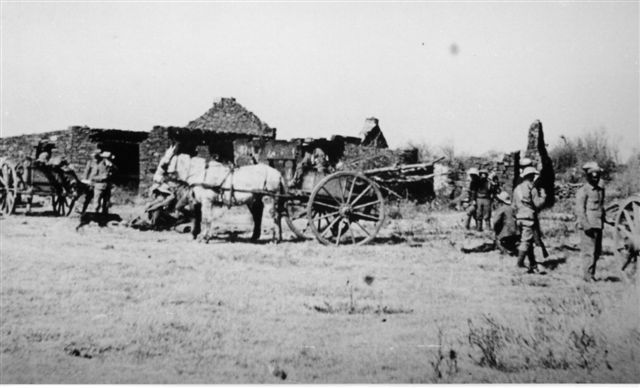
The Boshof landdrost district, where my grandfather farmed, became one such region. My grandfather's farm was not destroyed immediately. All the while his older sons Hamilton, Stoffel and Louis were fighting nearby. After several weeks, however, a British half company arrived at the family farm outside Boshof village. They told my grandfather they had come to destroy everything on the farm. The family and the farmhands were ordered to gather a few personal items together and to wait outside the house. Some young soldiers wandered through the house, helping themselves to things they could eat or articles to sell or to keep as soldiers in a foreign land so often do.
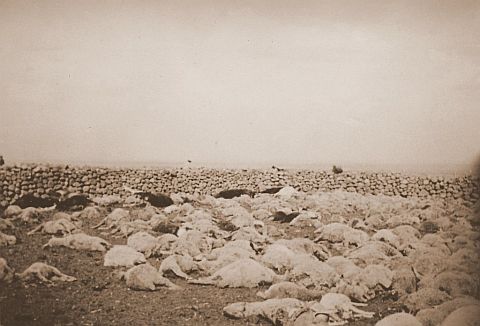
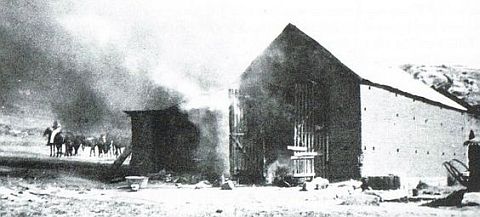
Then men set about slaughtering the cattle and sheep, using the butts of their Lee-Metford rifles to knock in the animals’ skulls. Some non-commissioned officers selected a few oxen to hitch to two wagons and stood watching the family load the few chattels they were allowed to keep. Then the soldiers set fire to the house, the outbuildings and the barn. My grandmother, herself a Murray and of Scottish descent, refused to let them see her weep and stood silently looking straight ahead, so my father told me.
Once the fires had taken hold of the buildings, the family was loaded into the wagons and they and the Black farmhands and their families began the journey to Kimberley.
Alone of his possessions my father thought only of saving his cat. Cats havealways played a large part in our family's lives, as they still do. And so ten-year-old Frans at least had the comfort of his little cat. He never told me its name, how old it was, its colour or its sex. He only said that he had been allowed to keep his cat.
Today the direct road southwards to Kimberley is not long, only 30 miles, but even a hundred and twenty-four years on, it is still a bad road, wet and slithery in summer, and in winter dry with thick clouds of Free State dust rising at the slightest disturbance. Even today it can take up to two hours if you want to spare your car.
The journey took the family nearly a week. They never moved further than the next farm before the burning and slaughter commenced again, farm after farm. It appeared that no one was to be spared, not the Black farm hands, not the bywoners, not the hensoppers. Any farm that could be used to feed and house the Boer commandos was destroyed. Although this may seem contrary to the original orders issued by Roberts, he had reckoned on so wide an area as being ’disaffected’ that it seemed to grow as the convoy moved.
Each afternoon late they stopped and the oxen were outspanned. The soldiers did not concern themselves with the prisoners except to walk around handing out rations of tinned meat, hard soldiers' biscuit, and water. When the wagons arrived in Kimberley the 'refugees', as the British called them, were formed into a wagon camp on the edge of the town, what the British called a leaguer. They were all very dusty and bedraggled. There was very little water to wash and my grandmother had only brought a single bar of homemade soap. The children and the farmhands had walked most of the time and they were footsore and exhausted.
My grandfather, who was 63, had been ill for a long time and he and my grandmother had ridden on a wagon. But the autumn sun, which had not yet begunto weaken, exhausted even the parents. The British did not pay much attention to the captives. But for the rations issued daily they would have thought that they had been forgotten. The group that had been rounded up together remained in the laager for two months. After a while my grandfather began to ask about the future plans for the group and he found out from the Medical Officer who once visited the captives, that in his poor health he could ask for special treatment. He applied for release and the officer commanding the group and the Medical Officer interviewed him. After some thought the officer - the administrator - asked whether my grandfather had been on commando when the War began. "No", replied my grandfather, "the commandant knew that I have been sick for some years and, anyway, because of my age he did not call me to join the Boshof Commando." After that the officer wrote a letter. When some days had passed a reply came and he sent for my grandfather again. "You cannot go home," he said, "there is nowhere for you to go near Boshof. You will have to go to the Cape and live near a British garrison under supervision, perhaps at Simonstown. But you will be on parole."
My grandfather, Petrus Fourie, did not like that because he had heard that only convicts were on parole. But he signed a paper written in English and after more waiting the family were told to pack up and were taken to the Kimberley railway station. The other people with them were also being moved to the concentration camp that had been set up at Norval's Pont at the edge of the Free State's border with the Cape. Forlornly the group ofwomen and children and a few old men sat next to the railway line at the goods siding where the wagons and coaches were shunted waiting to be loaded in the wintry sun. They had not seen the farmhands and their families since they arrived. Bored by the waiting my father began playing with his cat, taking it out of the little box his father had made for it. There was no milk for anyone and so he began to search for some water for the cat. As he searched he drifted away from the cat. The station was busy with the hubbub of soldiers loading trucks with themselves or with crates and equipment. A locomotive came coasting down the platform, as locomotives do, and then as it lost speed the driver opened the steam valves and there was a rush of escaping steam.
My father was startled and looked up at the steam engine. When he turned back to his cat it had fled from the noise. Within minutes the family were told to move into a closed luggage wagon which the locomotive had drawn up nearby. Although Frans ran about searching and calling its name, his mother called him into the carriage and they were on their way. All he had left was the cat's empty box.
I listened in silence and my Dad never spoke to me of the War again.
About the Author
Military History Society Life Member Deon's previous - and fourth - article was about Cpl Job Masego's Military Medal in the June 2022 Military History Journal.
Photographs inside the Journal are only black and white.
Return to Journal Index OR Society's Home page
South African Military History Society / scribe@samilitaryhistory.org