
 The South African
Edited by Brian Culross
The first man is Lt (as he was when this story opens) Lawrence Baillie, MC and Bar; the other Sgt. (as he was when this story opens) Gerard Ross 'Toys'(1) Norton, VC, MM, both serving at the time in the Kaffrarian Rifles(2), an Eastern Cape unit. Baillie was the great grandson of John Baillie, R.N., who founded East London in 1848, the town where Norton was educated, and which he regarded as his home.
A Great Trek The tale begins with the fall of Tobruk in June 1942 and the passing of the 2nd South African Division (including the Kaffrarian Rifles) into captivity. However, Lt Baillie, with Sgt. Norton and two others, managed to evade capture and on 21 June set out on an epic 38-day trek towards the Allied - in this case New Zealand - lines. The distance is 300 miles (480km) as the crow flies; but by 28 July,following the coast road [this assumption is made because it was the only way to survive: it provided both navigational guidance and the opportunity to find occasional abandoned or lost supplies. The open desert would have provided neither.] they had covered 472 miles on foot (760 km), a daily average of nearly 13 miles (20 km). They travelled at night to avoid the heat and enemy units, and were helped from time to time by Senussi Arabs, surviving on what food and water they could find in wrecked vehicles - even water from rusty radiators - and on Arab handouts. On 28 July, they came across an abandoned German truck in working order, and in this they completed the final two days of their epic journey. The hardships they endured in the course of their escape had reduced them to skin and bone: they had lost about 25% of their previous body weights.
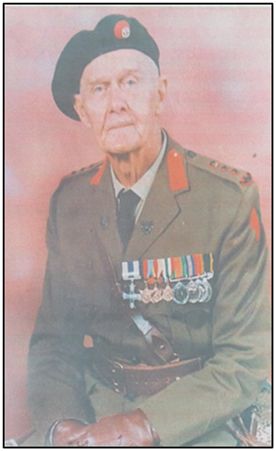
Col Lawrence Baillie as the
Honorary Colonel of the Kaffrarian
Rifle Regiment after World War II
For the endurance and determination shown, Baillie was awarded the Military Cross, with the Military Medal going to each of his three companions.
Exploits in Italy
Baillie and Norton were given leave in South Africa (presumably so were the other two, but that is not recorded). There, Norton received promotion to Lieutenant. However, the Kaffrarian Rifles already had an oversupply of officers, and so the two of them - Baillie and Norton - were seconded to the 1/4th Hampshire Regiment (D Company). Before long their new Regiment shipped out to take part in the Italian campaign.
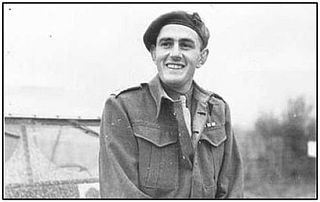
Lt Gerard Ross 'Toys' Norton
On 31 August in 1944, their unit was involved in a sharp fight at Monte Gridolfo, at the eastern end of the Gothic Line, a little south of Rimini, northeast Italy. Here Lt. Norton won the Victoria Cross, awarded for selfless bravery in attacking single handedly, and eliminating, three machine gun nests that were holding up the advance of his platoon, in the process killing or capturing no fewer than 18 German soldiers.
The award of the Victoria Cross was gazetted on 24 October 1944.(3)
The citation reads:
,i>On 31 August 1944 during the attack on Montegridolfo, in Italy, Lieutenant Norton’s platoon was pinned down by heavy fire. On his own initiative and with complete disregard for his own safety, he advanced alone and attacked the first machine-gun emplacement, killing the crew of three. He then went on to the second position containing two machine- guns and 15 riflemen, and wiped out both machine-gun nests, killing or taking prisoner the remainder of the enemy. Throughout these attacks he was continuously under fire from a self- propelled gun, nevertheless he calmly went on to lead his platoon against the remaining enemy positions.
Two weeks later, on 16 September, the Hampshires mounted another attack on the Gothic Line, this time at Tra Riva. Baillie distinguished himself, receiving a bar to his Military Cross, but in the process received no fewer than six bullets in his left thigh, leaving him with a shattered femur.
After the War – ‘Toys’ Norton
In February 1946 Norton, now 'demobbed', and with the rank of Captain, moved to Southern Rhodesia where he became a tobacco farmer. Three months later he took out Rhodesian citizenship.
In 1951, following a decision by the South African government that cities would henceforward be allowed to confer "Freedom of the City" on deserving persons, Norton received this honour from East London on 23rd August 1956. He thus became the very first recipient so honoured by the city. A year later the same honour was bestowed on the entire Kaffrarian Rifles.
Shortly after the ceremony, Norton travelled to the UK to take part in the 1956 Victoria Cross centenary parade in London.
In November 1965 Rhodesia declared unilateral independence (UDI) from the UK. Shortly thereafter, Norton was invited to attend a reception for VC recipients in London. There were, however, conditions. Following UDI, considered unlawful in Britain, his Rhodesian passport was no longer regarded as valid by the UK authorities. He was offered a concession: if he surrendered his passport he would be granted a special visa in order to make the trip. Norton, loyal to his adopted country, refused.
Norton continued as a tobacco farmer in Rhodesia until 2002, when he was forced off his farm by Robert Mugabe's followers.
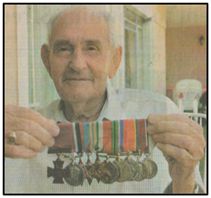
The photo of Norton and his medals
was taken at about that time.
Two years later, on 29 October 2004, Norton passed away.
After the War – Lawrence Baillie
Baillie survived his wound, though his leg was permanently six inches (15 cm) shorter than the other, and he had to wear a built-up shoe to make up for the difference. The disability did not end his military career, however, as will be noted below.
Initially, though, he returned to civilian life and to his position at Barclays Bank in East London.
In 1947 Baillie, by now with the rank of Colonel, "Colonel Lawrence Baillie M.C. & bar, e.d.(3)" was appointed C.O. of the Kaffrarian Rifles for two years, until 1948. Much later, in February 1965, and until his death in July 1998, Baillie was made the regiment's Honorary Colonel. After Col. Metcalfe of the Durban Light Infantry, Baillie seems to have been the second longest serving Honorary Colonel of any SA unit at that time.
A Personal Note Brian Thomas writes: "I met Lawrence Baillie in East London in 1989 [w]hen he gave me a signed copy of his 55-page document "38 Days Desert Trek. I was privileged to spend an afternoon chatting to this remarkable man ... he autographed my copy of the Kaffrarian Rifles history [and] showed me the 6-inch thick sole to his left boot."
References and Notes
(1) Wikipedia on Gerard Ross ’Toys’ Norton:
Early life:
Educated at Selborne College, East London
(where he acquired his nickname)
he was a keen sportsman excelling at
cricket, rugby and tennis. After school, he
joined Barclays Bank at Umtata. After a
short spell in the Johannesburg branch of
the bank, he returned to East London. The
hostel at Selborne College is named in his
Honour.
(2) Military career Norton’s peacetime military training was done with the Middelandse Regiment, but after the outbreak of the Second World War he was transferred to the Kaffrarian Rifles (now the Buffalo Volunteer Rifles) in East London. In 1943, he transferred in to the 1/4th Battalion, Hampshire Regiment (later the Royal Hampshire Regiment).
The award of the Victoria Cross was gazetted on 24 October 1944.
He later achieved the rank of Captain.
(3) e.d. Was the Commonwealth equivalent of the British T.D. Awarded for long part-time service in the military.
About the Author
Brian Thomas has written several articles, mostly about medal awardees, inprevious Journals.
He is an Honorary Life member of the Society, lives in Durban and is supported in his hobby of military history by Barbara, his wife of over 62 years.
Return to Journal Index OR Society's Home page
South African Military History Society / scribe@samilitaryhistory.org