
 The South African
Introduction:
In Part I we followed the fortunes of the British Army's Balloon Section 1 as it worked its way from Cape Town to Pretoria with the main force. In Part II, we look at what befell Section 2.
Balloon Section 2
Section 2, commanded by Major G.M.Heath(2) had been sent out to Durban, in anticipation of war(3), on 30 September 1899. It disembarked on 26 October and while base details set up a gas plant in Durban the field element was immediately dispatched by rail to Ladysmith with several balloons. It arrived the following day (27th), just in time to take part in the final action undertaken by General White (in command of the Ladysmith troops) before the Boers completed their encirclement of the town.(4)
This would become known as the Battle of Ladysmith, or Lombard's Kop, during which everything went wrong for the British in a sequence of errors. On Monday 30th October, General White launched attacks to the north and north-east, intending to dissuade the assembling Boer forces from assaulting his town. The Balloon Section hastily inflated and flew their balloon for this battle (either for the first time on this day, the 30th,(5), but more probably at least one(6) and most likely two(7) days prior) to keep an eye on Boer movements. Stott relates that it was a message from the balloon observer that alerted General White to the perilous situation of his left-flank force at Nicholson's Nek, while Conan Doyle reports that the troops at the Nek tried (as they thought, in vain) to alert the balloon by flag and by means of a heliograph mirror fashioned from a polished biscuit tin.(8) An eyewitness account (that of Sergeant Hayward, of the Rifle Brigade) says at least one of the balloons - presumably on the 30th - was "attached to an armoured train" and sent down messages correcting the covering fire being laid down by the field artillery.(9) Taylor claims this was one of two occasions when a balloon achieved its "best results".(10) On the other hand a member (anonymous) of the besieged forces identifies as a blunder the handling of the balloon on the right wing of the attack. This was to be the main effort (under General Grimwood), and 'anon' states that two days before the battle a balloon had reported the hills that would flank the advance to its right were clear of Boers, but that no further inspection was carried out before the attack took place. In the interval the Boers, of course, had occupied this high ground, and Grimwood's column was enfiladed with grim results.(11)
Two balloons were sent up in succession the day after the battle, both of which had to be hauled down for patching, as the Boers managed to put a few bullets through them. The chances of exploding the balloons was very slim (as, later on, frustrated airmen firing ordinary machine gun bullets would discover in the Great War) but holes meant loss of gas, and once besieged, the balloonists had on hand only the gas cylinders that had travelled with them, and no means of obtaining, or manufacturing a resupply.(12)
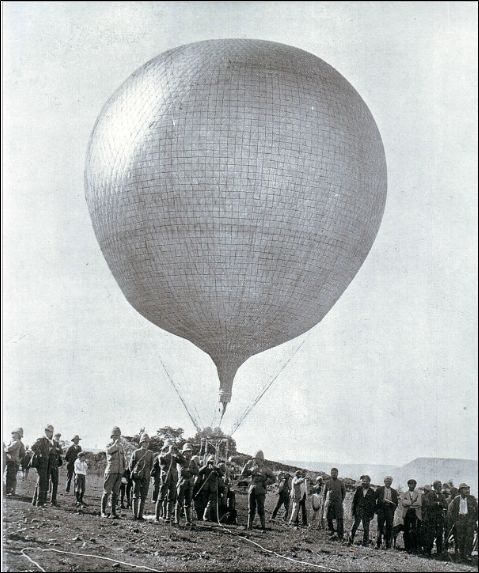
The Ladysmith balloon
Most of the hits scored on the balloon occurred when it was low, within about 60 yards (55m) from the ground. Then the range was easy to estimate by reference to the surrounding ground features. Above that elevation range estimation became increasingly difficult (there are no special features or land-marks in the sky). Reports of the number of hits scored by the Boers vary considerably. The anonymous writer referred to in note 11 (below) says 'three', but this seems to refer to shellfire, not rifle fire. Speaking to a London audience in 1901, Col. Templer claimed "Several balloons were absolutely destroyed by shell fire", which seems to have been a case of 'rostrum hyperbole', for he also claimed that the balloon(s) drew all the Boer fire onto themselves, which was patently not the case.(13)
A balloon ascended almost every day during the siege until the gas ran out (on the 27th day).(14 )In fact, for the first few days two balloons were sent up, though soon - no doubt on account of the need to make the gas supplies last as long as possible - only one balloon was used.(15) Most accounts agree that the balloonists were able to pass down helpful messages about Boer movements and gun positions, as well as guide the gunners onto their targets. The balloonists also made a map of the country between Ladysmith and Colenso to the south so as to better liaise with General Buller's relief force when it approached. In the generally clear air of the Natal hills the observers could see half as far again - to 10 or 12 miles (16-20km) - as in England.(16) The ascents had to be carefully managed, because Ladysmith was already about 3 500ft (1 065m) above sea level. For the balloons to rise to a useful height they had to be well filled and lightened as far as possible. In this way they could manage ascents of up to about 1500ft (450m).
(The same considerations applied to all the other Sections in South Africa.) General White was as generous in his after-action dispatch (dated 23 March 1900) as Methuen had been. Describing Major Heath as "a bold and enterprising aeronaut, [who] rendered useful service; the constant watch which he kept on enemy’s movements being a source of much disquiet to them." For his work with the balloons, Major Heath was in due course awarded the DSO (Distinguished Service Order).
Once the balloons were grounded by a lack of gas, the balloonists were put to work on the town's defences, especially those on the southern flank. The Section was not reconstituted after the siege was lifted, but converted into the 3rd Field Troop, and attached to the cavalry.(17) The principal reason for this was that much of Buller's contemplated advance from Ladysmith would be along the line of the Drakensberg escarpment and its extensive system of foothills - country particularly unsuited to balloon work.
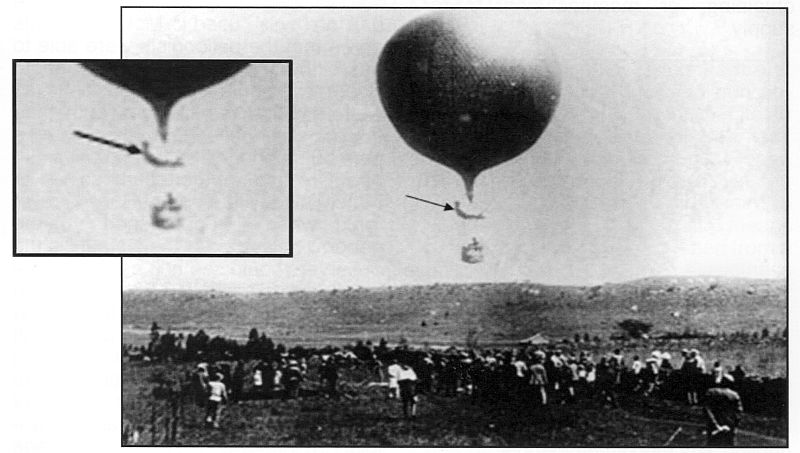
Note the second observer perched (lying back)
in the rigging (arrowed) because the basket was
only big enough for one man to move around in.
The Extemporised Balloon Detachment
Meanwhile, with No. 2 Section bottled up in Ladysmith, an expedient was needed to provide Buller with aerial reconnaissance for his immediate mission, that of relieving the town. That expedient was an extemporised balloon detachment made up, through the energies of Capt. G.E. Phillips, from spare equipment and men held at the base in Durban, plus others drafted in from other units as needed.(18) Inevitably, willing though it was, it was short on both experience and equipment. It moved north and joined Buller's forces at Colenso in mid-January. Colenso lies some 12 miles (20km) south of Ladysmith on the right bank of the Tugela River, which flows, very sinuously, from west to east. The north bank is very hilly and provided the Boers with a grandstand view of Buller's every move on the flatter south bank, while at the same time concealing many of their dispositions and movements, even from the balloon's view. More than this, high hills and narrow valleys do not make for ideal ballooning country, for they funnel wind in unexpected directions, to the periodic discomfort and disarray of balloonists. (Even today, flying balloons in mountainous terrain is regarded as something of an 'extreme sport').
Breaking through to relieve Ladysmith would not be easy. In fact it took Buller four attempts: the first just to the left of Colenso on 15 December 1899, the next a far-flung left hook at Spion Kop (24 January), then a closer-in left hook at Vaal Krantz (5 February), and lastly the second and successful series of thrusts from Colenso (from 22 to 28 February, the day his cavalry rode in to Ladysmith). The first three attempts were all mismanaged or fumbled, the last more methodical and business-like.
There are few references in published sources to the specific work of Phillips' ad hoc unit.(19) Most content themselves with the phrase "good work was done", or some equivalent. Where details do occur they tend to be - as so often! - at odds with each other.
Walker asserts that Phillips' unit took part in Buller's initial attempt to storm through at Colenso on 15 December; Mead, on the other hand, states categorically that it did not, and Wilson implies it didn't arrive until the Colenso affair was over.(20) If a balloon was present, it can have achieved little, for the attacks took place in ignorance of the Boer dispositions, and on the basis of misleading maps. Had the balloon been operating, both deficiencies might have been made good. In the event, the day was a disaster for the ill-informed British.
On 18 January 1900, the balloon was up observing for a feint attack at Potgieter's Drift, midway between Spion Kop and Vaal Krantz. Visible from Ladysmith, it looked "hardly bigger than a vulture against the pale blue of the Drakensberg precipices".(21) This feint was designed to distract the Boers from noticing General Warren setting out with two thirds of Buller's army to the west in a wide outflanking march that plodded when it should have galloped. The balloon, as always, was subjected to outraged but mostly ineffectual Boer fire; but on this occasion a marksman managed to score an admittedly non-fatal hit on Phillips himself.(22)
On 23 January the balloon was still up opposite Potgieter's Drift (as it was most days, observing as best it could the Boer positions from Spion Kop on the left to Colenso on the right). This was the day before the Spion Kop attack, and when the balloon reported Boers moving through the hills towards Colenso, the anxiety arose that they were planning their own flank attack while Buller's forces were mainly concentrated at the other end of the front. As it turned out this was a fairly small force responding to a British feint at Colenso, which neither the balloonists nor Lyttleton, the main but not overly strong anchor for Buller's right flank, had been told about.(23) This was a classic example of the misinterpretations an observer could make when not kept in the overall tactical picture.
The balloon's contribution to the Spion Kop affair is difficult to assess from the confusion of accounts. Some reports(24) assert the balloonists had pronounced the hill impregnable (presumably only because of its contours: there were hardly any Boers on it), but this clearly had no influence on Warren's ultimate decision to attempt the crest. The Times History says Warren requested the balloon to come westwards from the Potgieter's Drift area to carry out a closer inspection of his proposed battlefield, but left it too late for the request to be acted upon.(25) Templer is quoted as saying, in his speech to the Aeronautical Society, that the balloon "did some splendid work at Spion Kop", and this statement, or something similar, is copied in several other accounts. This author considers 'Spion Kop' may have been a slip of the tongue for 'Vaal Krantz', since no accounts of the fighting on the Kop mention any input from the balloon, and it is difficult anyway to see how it could have helped "splendidly", given that the advance was made at night; whereas it is reputed to have helped significantly at the Krantz. (See footnote 22 for a cautionary comment on Templer's presentation.) However, we must allow that from its position at Potgieter's drift, it could have noted at least some of the Boer activity out on the left flank and that this could have been passed to Warren in the indecisive days prior to the attack on the Kop.
Around the time of Spion Kop, apparently, one of the unit's balloons was hit by shrapnel, and then torn against rocks in what was presumably a misjudged 'landing'.(26)
At Vaal Krantz, on 25 February 1900, the balloon worked hard to direct the artillery onto Boer positions, and received payback in good measure from the Boers. So much so that the balloon had to be quickly hauled down to avoid being shot down. It's worth noting that in advanced positions the balloon was not always sent up attached to a winch (such positions, in this war, were often not wagon-friendly). Instead the cable was let up by hand through a pulley system, the 'tail' of the cable being securely anchored. When rapid haul- down was called for (as here) a snatch-block pulley with a length of rope or a long pole was clipped onto the cable and dragged rapidly away by a team of men (or even horses, as an artist's drawing in Wilson(27) implies took place in this instance). In this way the anchored balloon cable - and progressively the balloon - was drawn down to the ground. This is quite probably how the balloon came to be damaged on rocks around the time of Spion Kop (as recounted above). In fact, Illsley asserts that the winches in use in those days were not powerful enough to haul down a balloon against its ascensive power, and that they were only employed to control the rate of ascent. Haul-down, according to Illsley, would always be by using the snatch-block method outlined above.(28)
Buller's frustrated attempts on the left at last brought him back to Colenso for what turned out to be the long- awaited breakthrough. Henty(29) says the balloon directed fire onto Green Hill during the preliminary manoeuvrings (18 February); Illsley that it observed at the battle of Pieter's Hill, almost the last exchange of fire before the relief of Ladysmith took place.
The prudent reader will scatter a generous allowance of query marks over this tale of the activities of the 'Extemporised Section', for as earlier stated, no formal contemporary account of its deeds exists. Prudent writers have kept their accounts free of specifics - little help to the modern enquirer. It is, however, definite that once the Ladysmith campaign was over Phillips' men were dispersed back to their parent units or re-joined their comrades of Section 2, and in the latter case - like them - were transformed back into men of a regular Field Troop.
(To be continued. Note: a full list of sources will be given at the end of Part III.)
Footnotes
1 Pakenham and Kruger have been used to provide the general background to this section. Many other texts are available at www.angloboerwar.com.
2 Eventually a Major-General.
3 War began 11 October 1899
4 These dates (26th, 27th) are those given by Walker (p.17). He does not state the mode of transport but only rail could have made it in the time available.
5 According to Broke-Smith, p.17.
6 Wilson, I, p.35; Kruger, p.89; Chisholm,
7 Walker (p.22) gives 'two or three days' and a member of the besieged force claims (in The Aeronautical Journal of January 1902, p.15) that the balloon was reconnoitring the Boer positions two days before the battle.
8 Stott, p.89 & Conan Doyle, ch.7.
9 Quoted in Boyden et al, p.157. There seem to be no other references to an 'armoured train' at Ladysmith, so probably the eyewitness was embellishing an engine with a couple of re-purposed coal trucks.
10 Taylor, p.24 (approx.). See also Illsley, p.15.
11 Anon in The Aeronautical Journal, Vol. VI, No. 21 (January 1902), p.15
12 This author has been unable to find any firm evidence that Ladysmith had a gas works - on the contrary, it is almost certain that it didn't - not least because it was after all, only a rather small town. Stott (p.142) refers to the balloon being "fresh charged at the gas works" but this is probably a journalist's casual assumption - certainly it is not firm evidence. And in any case, town gas would not have been buoyant enough to lift the relatively small hydrogen balloons the British used.
13 Templer, reference provided.
14 Churchill [1] (Ch.24) makes the curious remark that from Ladysmith a "Captain Tilney" had ascended in a balloon on 28 February to observe the Boers' final retreat in the face of Buller's successful assault on their Tugela positions. How such an ascent could have taken place in the absence of any gas is a difficulty (was it a home-made hot-air balloon?). The tale surely cannot be true.
15 HistorikOrders web site (Medals gallery p.50: anonymous diary)
16 Anon, Aeronautical Journal, Vol. IV, No.13, p.96
17 Watson, p.118
18 The creation of this ad hoc unit is the origin of the erroneous statement, often encountered, that four Balloon Sections went out to South Africa.
19 According to Walker (p.23) no proper record of Phillips' work was ever made.
20 Walker, p.23; Mead, p.23; Wilson, p.238.
21 Nevinson, diary entry for 19 January 1900.
22 Mead, p.23. Templer says the wound was to the cheek. (Note: he refers to Phillips as 'Peters'; thus one needs to ask what other errors he may have made in what appears to have been an extemporized speech. It must be noted he was not with the balloons during the war, but elsewhere, in charge of the steam traction transport.)
23 Amery, III, p.242
24 Hildebrandt, p.151 (approx.); Templer; Bruce, p.5.
25 Amery III, p.300-301. Amery castigates both Buller for not giving Warren the balloon earlier and Warren for not asking earlier.
26 Wilson, p.312
27 Ibid, p.311
28 Illsley, caption to illustration on p.13.
29 Henty, Ch.18. Although this is a fictional work, Henty makes it clear in his preface that the description of events is as accurate as he has been able to make it.
About the Author
Brian Culross wrote about military balloons in Paris in the June 2020 Military History Journal; an opinion piece about Napoleon as well as several poems in the June 2021 MH Journal and about the plight of widows in WWI a year later. Several more poems as well as a surprise from Patience Strong also came from his pen.
He has been a member of the editorial panel since December 2020
This is the second part - of three - about the British use of balloons in the South African (Anglo-Boer) War.
Return to Journal Index OR Society's Home page
South African Military History Society / scribe@samilitaryhistory.org